
My background:
- PhD in Sport & Exercise Science for University of Technology Sydney (Australia)
- Head of Academy Performance at Juventus FC
- Training load monitoring & physical assessments
Research Project
The rapid growth of wearable technologies has transformed how training and match load is being monitored in elite youth soccer, with practitioners now collecting a vast quantity of data on a daily basis. While this wealth of information offers enormous potential, it also creates a practical challenge: which metrics actually matter, and how many are truly needed to understand the demands placed on developing players? Reducing the dimensionality of the data collected can directly aid the interpretability of the variables, lower the time required to assess and interpret these data and consequently their impact on the decision-making process relating to future training.
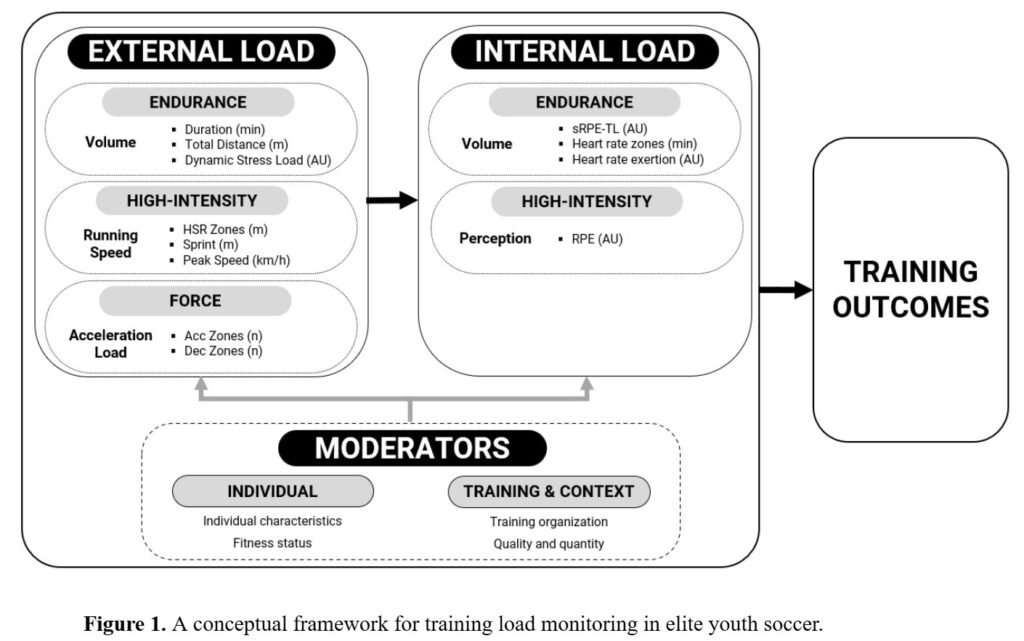
This study aimed to implement a guided approach to the reduction of variables being assessed by combining knowledge available in previous literature with expert opinion, prior to employing statistical methods for data reduction to help guide the selection of metrics. The attached figure presents the conceptual training load framework developed to help describe the intermittent nature of soccer and the physical stressors players are exposed to, detailing the macro-categories within the primary load constructs and the specific metrics identified for inclusion.
These variables were recorded across 2 competitive seasons, with every training session and match monitored using heart rate monitors (Polar Team2 system), micro-electromechanical systems device (VIPER, STATSports) and players perception of effort (RPE). The data from 145 elite youth players aged Under 15 to Under 19 was assessed using a statistical data reduction approach called Principal Component Analysis (PCA). This technique examines how different load variables cluster together and how much variance they explain within the dataset. In addition to this, a separate sub-analysis was performed to investigate whether using absolute measures (total load) and relative measures (load expressed per minute) had an impact on the metrics retained.
The main findings highlight that training and match load in elite youth soccer cannot be described by a single load metric or construct. Across all age groups, three to four principal components were required to describe 64 – 71% of the variance recorded in training load, with each component representing a distinct but complementary aspect of player demands. Importantly, these components aligned closely with the conceptual framework, explained similar amounts of variance, and reflected four recurring load “themes”:
- Total volume of load (e.g., total distance)
- Acceleration load
- High-speed running exposure
- Heart rate load / physiological stress
Differences between absolute and relative PCA outcomes were minimal and did not change the practical conclusions, as the same fundamental load constructs were retained. However, the interpretation of specific variables should remain age and context dependent within a standardized athlete monitoring system because differences were observed in both the ordering and weighting of components across the different age groups (U15–U19).
A novelty of this study was the inclusion of both objective and subjective internal load variables. Heart rate–based measures were consistently retained across age groups and often emerged as an independent component, thereby, confirming that the inclusion of a measure of physiological stress can help to provide additional information not captured by GPS-derived metrics alone. While, despite being a measure of internal load, players individual sRPE and sRPE-TL did not load alongside heart rate measures. The added value of subjective measures alongside those provided by wearable microtechnology was reinforced by the relative (per-minute) load PCA where there was a clearer separation of sRPE based variables as a standalone component.
It is important to note that the PCA alone did not meaningfully reduce the number of variables beyond those already identified through the conceptual framework, helping to validate the inclusion of the different constructs identified. From an applied perspective, this suggests that the true value of data reduction lies less in eliminating metrics and more in clarifying which load constructs should be monitored and how they should be interpreted.
Take-Homes and Applications:
These findings confirm that training load is a complex, multidimensional phenomenon that cannot be captured by a single variable or construct of load. The close alignment between the outcomes of the guided PCA and the conceptual training load framework provides strong support for the implementation of a framework led approach. Although minor differences in component structure were observed across age groups consistent load themes emerged, highlighting the central role of total distance, high speed running, accelerative demands, and internal load responses. In summary, effective monitoring systems should integrate both external and internal load measures to support decision making in elite youth performance environments.