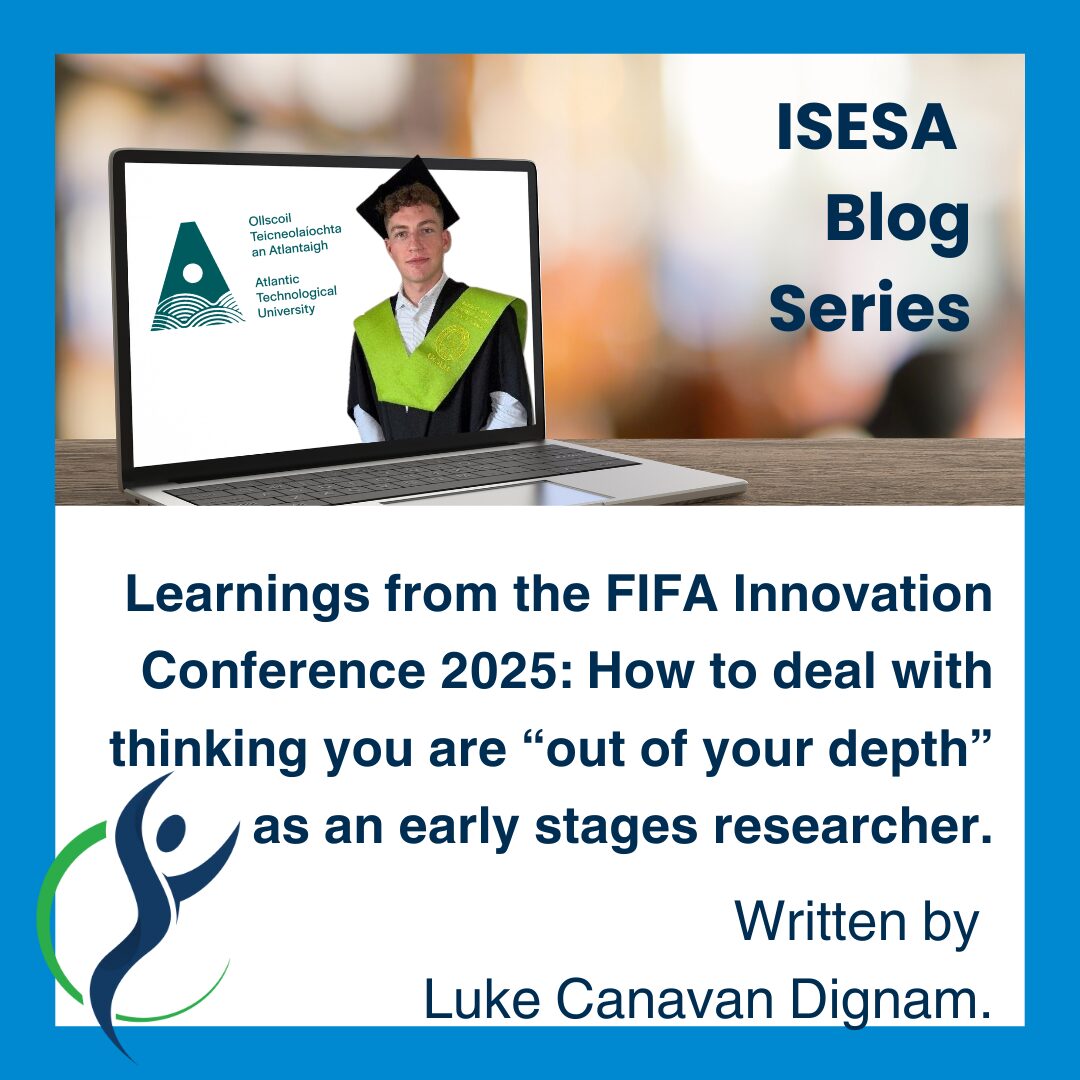
My background: I am a second year PhD student in ATU Galway, under the supervision of Ed Daly, Lisa Ryan and Michael McCann concentrating my research on artificial intelligence, specifically using skeletal tracking and computer vision to identify and reduce the prevalence of sport related concussion, with a concentration on female athletes, developing a democratic and available tool that can be used at all levels of sport, from grassroots to the pinnacle of elite sport. Outside of academia, I am one of the coaches on the Triathlon Ireland pathway squad.
Conference: The FIFA Innovation Conference was held at the FIFA Headquarters located in Zurich, Switzerland. I was fortunate enough to have been extended an invitation to attend. This bi-annual conference ran its second iteration on November 11th -13th . The conference’s aims are to foster collaboration between researchers, technology partners, national governing bodies and global sports bodies on current and oncoming challenges faced in football globally. The conference accentuated the necessity for creating more accessible and represented technology not only in the game but in research.
The first event of the conference was a social networking evening with a tour of the “innovation in action” exhibit which was in the FIFA Museum in the centre of Zurich. The exhibit is to display what work has been done since the beginning of the sport, with of course a concentration on technologies developed in the last decade where most progress has been made, with Video Assistant Referee (VAR), then Semi-Automated Offside Technology (SAOT) now with Semi-Automated Last Touch (SALT). Smart footballs, referee bodycams, video replay assistant tools, dashboards, jersey fabrics, and many more developments were all on display in the museum.
Following the tour, the daunting part started. Networking. Working the room as they say. How did I work the room? I worked my way out of it as fast as possible. The only conversation I attempted was with one delegate from the Saudi Arabia Federation. You can imagine how awkward and short lived a conversation between a 24-year-old, Irish, early stage researcher went with the 60+ years old delegate who was known by the entire room, which was full of similar, high-profile candidates. Before leaving the room, I looked around. Nike Innovation. Adidas. FIFPRO. HAWK-EYE. IFAB. MIT. I think I nearly had a panic attack from the profile of people in the room. I left the event, tail between my legs. There were many questions running through my head like; “Should I be here?” “Should I have left, was that silly?”.
Day 1 of the conference comes in. Full of great presentations, with a large focus on democratic, accessible technology, international data standards and rules, match official developments, with talks from Pierluigi Collina himself. I had come into this day with a fresh head. A renewed mentality. Come lunchtime, I had defrosted a bit and managed to ease myself into networking with those who were presenting posters. While it was hard being by myself and feeling totally out of my comfort zone, I already had some career defining take-aways. I was invited. So were these people. Did I stand out as much as I had thought? Well probably to the baristas who saw me nervously take maybe 8 coffees for myself through the day. Maybe to the folk who saw me holding up the wall during the coffee breaks. But had I just gone up and asked that question I was afraid to ask, I may have initiated a conversation that could give me access to data or participants not publicly available, or a funder who took special interest after your conversation.
These findings were taken into day 2, where the conference portion was quite short and limited in personal PhD applications. which presented an opportunity to network. I had convinced myself to ask those questions I was previously afraid to ask. Now, I have many connections that are going to directly affect my PhD, with researchers whose work is directly aligned with mine. I left the conference content with the newfound collaborators to my research.
As an aside for those more interested in this conference’ presentations and topics; This conference was oriented to research partners for FIFA along with technology collaborators such as Lenovo for computing, Riedel body cameras, Hawk-Eye for broadcast data to name a few. The conference concentrated on AI such as Skeletal tracking, the prospects of mesh tracking, AI annotations for performance analysts, data cleaning. My biggest take-away should apply to all of those involved with technology in sport science, and that is democratic technology, and making our developments available and accessible to all, at all levels however we can, and to always consider the end user first. Please feel free to reach out to me for more information on any talk or the conference itself.
As you may have gathered by now, although I found quite a large portion of the conference applicable to my PhD, the true learnings for myself were spiritual and about self-confidence. Finding my researcher voice. Do uncomfortable things, it’s probably what (I) we all need more of.
The one thing I am trying to shout to those in the bleachers, the nervous undergrads at any conference, the PhD student at a conference by themselves, even the distinguished researcher who might be having a rough day. You are where you are not by chance. Always a student. Meet those who share the same outlook at conferences, be wary of those who don’t. Don’t be afraid of asking questions you might think aren’t good enough.
Biography
Luke is a second year PhD student in ATU Galway, under the supervision of Ed Daly, Lisa Ryan and Michael McCann concentrating his research on using Artificial Intelligence, specifically Skeletal tracking and Computer Vision to identify and reduce the prevalence of Sport related concussion, with a concentration on female athletes, developing a democratic and available tool that can be used at all levels of sport, from grassroots to the pinnacle of elite sport.
LinkedIn: Luke Canavan Dignam
ResearchGate: ResearchGate
ORCID: Orcid