My background: From a young age, I have always had a love of sports, in particular sports science. My playing background includes athletics, basketball, hurling, and Gaelic football, which deepened my passion for sport and inevitably led me to choose to study for a BSc Sport, Health and Exercise Science at UCD.
I am currently in my final year, conducting a thesis on the relationship between sleep and sprint performance in youth paralympic athletes. I am also currently working as the assistant strength and conditioning coach for the Dublin Senior Camogie Team, lead strength and conditioning coach for the Kilmaccud Crokes Senior Camogie team, and UCD Lagan Cup team manager. This blog is very much a crossover between the Relative Age Effect I have seen and experienced in GAA, and whether it has a similar effect in the world of Para athletics.
Background
The Relative Age Effect (RAE) refers to the advantage individuals born earlier in the calendar year have over those born later that year, which was first reported in 1988 by Barnsley and Thompson.
Growing up playing GAA, I saw RAE firsthand. As in all sports, at young juvenile ages, there can be a large difference in the physical development between two kids who are over 6 months apart. However, in my experience, in Gaelic games, the more physically developed players can come to the fore at a young age. This can involve them playing with older age groups, giving them more responsibility in games, and selecting them for county development trials. This creates a significant gap between the exposure players receive on the field and contributes to the prevalence of the RAE in GAA. Numerous studies have found the RAE in juvenile development programmes. Fitzgerald et al. (2024) found the RAE in U14 and U15 talent development groups, and McGonigle et al (2023) found RAE in youth soccer and Gaelic football development squads. Importantly, McGonigle et al. (2023) concluded that as RAEs’ prevalence increases with age and depth of competition, coaches’ expectations are based on age, size, and maturity, rather than skills, character, or talent. This is known as the Pygmalion effect (Hancock et, al 2013).
During my placement with Paralympics Ireland as a Research assistant, it was pointed out to me that RAE has been evident in the Turkish Paralympic team (Bayarslan et al 2023). The study was conducted on 169 Turkish Paralympic athletes from different sports. The RAE was found with 96 athletes born in the first six months, with 73 being born in the second. The RAE effect was also found when split by gender and in former medalists. However, it was not found in Para Athletics, with only 6 of the 20 Para Athletes born in the first six months. These findings proved the existence of the RAE in Para Sport, but further research is needed, especially in Para Athletics.
So, drawing on Bayarslan’s promising research on Para Sport, previous findings, and my experience in GAA, I conducted research on RAE among the current Irish Paralympic team, the Para Athletics Academy, and Irish Paralympic medalists since 2008.
Research Methods
A total of 59 Irish Paralympic sport athletes were included (29 Paralympians, 14 academy athletes, 16 retired Paralympians who medalled between 2008 and 2024).
- Previous databases used for performance testing were used to acquire relevant DOB, sport and gender of each athlete.
- Excel was used to display the results in tables where athletes were grouped based on their Birth Quartile (Q1- Jan to March, Q2 April to July, Q3 August to September and Q4 October to December).
- Birth Quartile grouping charts were also made for each sport and gender.
- Medals won at each birth quartile were calculated
Results
No RAE was found in Paralympians, with 15% born in Q1, 30% in Q2, 32% in Q3 and 22% in Q4.
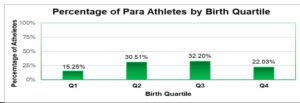
46% born in the first half of the year and 54% born in the second half of the year, contradicting the RAE.
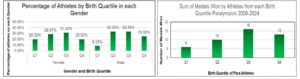
Further results did not find the RAE among Para Athletes when split by gender, with the majority of female athletes (51.43%) and male athletes (58.33%) being born in the last 6 months of the year. The majority of Paralympic medals won by Irish Paralympians between 2008 and 2024 were won by athletes born in Q3 and Q4 (29/45 medals).
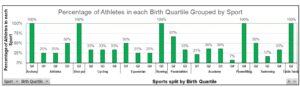
When split by sport, Para triathlon and Para table tennis players were mostly born before July 1st; however, this data refers to 3 athletes, who were born after July 1st. The rest of the Para Sports had the majority of athletes born in Q3 and Q4.
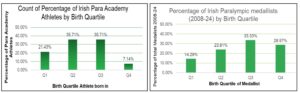
When comparing Birth Quartiles of Irish Paralympic medallists from 2008 to 2024 and Irish Para Athletics Academy athletes, the only similarity was Q3 having the highest percentage of both Medallists and Academy athletes. Although the majority of Para Athletics Academy athletes were born in the first half of the year (57.14%), this data is based on 14 academy athletes, a group too small to find a true RAE.
Conclusion: This study found no evidence of a Relative Age Effect (RAE) among Irish national Para athletes. Birth distribution was relatively balanced, with 46% born in the first half of the year and 54% in the second half, contradicting the typical RAE pattern. Similar trends were observed when data were split by gender, and most Paralympic medals won by Irish athletes between 2008 and 2024 were achieved by athletes born in Q3 and Q4, further suggesting that relative age does not strongly influence success in Irish Para sport.
These findings differ from many youth sport systems (GAA, etc), where RAE has been widely reported since the work of Roger Barnsley and A. H. Thompson. One possible explanation is that Para sport pathways may be less influenced by coach expectation biases, often described as the Pygmalion effect, potentially creating a more equitable development environment.
However, the small sample size (n = 59) and the limited number of Para Athletics Academy athletes (n = 14) reduce statistical power. Therefore, while the findings are encouraging, further research with larger samples and across additional national teams is needed to confirm whether RAE is truly absent in Para sport.
Author’s Bio:
Find me on LinkedIn