
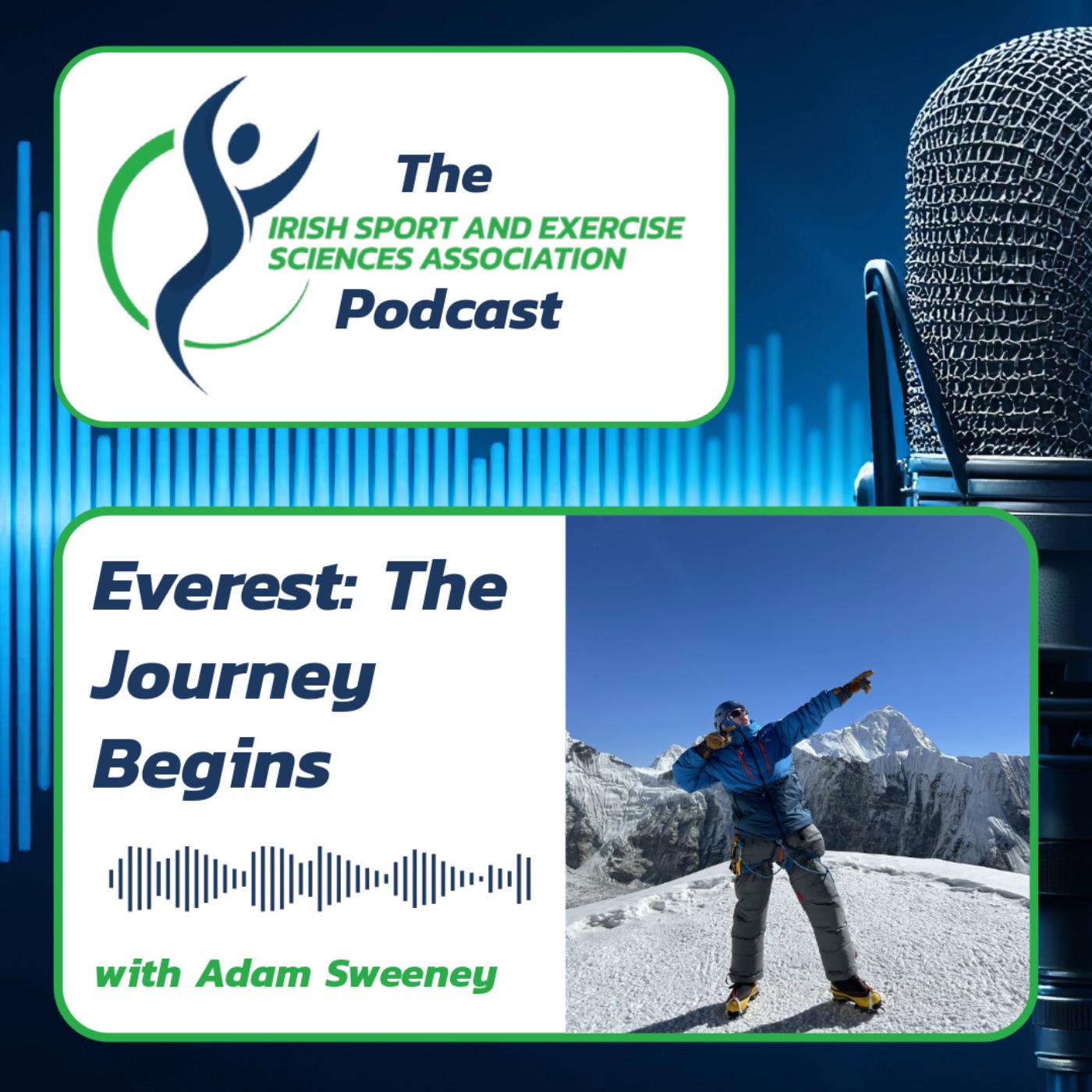
In this episode of the Irish Sport and Exercise Science Association (ISESA) podcast, Bruce speaks with Adam Sweeney, a 22-year-old adventurer from Waterford. Adam is preparing to begin a two-month expedition with the objective of becoming the youngest Irish person to summit Mount Everest.
The discussion tracks his progression through increasingly demanding high-altitude environments, analyzing his experiences on Aconcagua in Argentina (6,961m) and the technically formidable Ama Dablam in Nepal (6,812m). We detail the physiological realities of acclimatization, the acute effects of hypoxia, and his specific strategies for managing nutrition and hydration when performing at altitude. Plus Bruce and Adam discuss the the psychological resilience required to navigate objective hazards like the Khumbu Icefall and the physiological breakdown that occurs within the “Death Zone” above 8,000m.
You can follow Adam’s progress via his social media channels:
Hosted on Acast. See acast.com/privacy for more information.
S03 E12
Everest: The Journey Begins
Speaker: Hello and welcome to the latest episode of the Irish Sport and Exercise Science Association podcast. I’m your host, Bruce Wardrop, and in today’s episode, we speak with an individual preparing to face one of the most extreme physiological and psychological tests on the planet. Adam Sweeney is a twenty two year old adventurer from Waterford whose upbringing was rooted in the outdoors thanks to his family business, the Dunmore East Adventure Centre. I met Adam this morning and in just five short days, which should be the eight day this episode drops. He will depart for Nepal to begin a two month expedition with the goal of becoming the youngest Irish person to summit Mount Everest. Adam is very active on social media, and you can follow his progress by finding him at Adam T Sweeney on either Instagram or TikTok. Adam’s path to the Himalayas has been a progression of increasingly demanding endurance and altitude challenges during the Covid nineteen pandemic. He started by cycling the circumference of Ireland, summiting the highest peaks in every county he passed through. Next, he took on the UK Three Peaks Challenge, climbing the highest peak in England, Scotland and Wales, all in just twenty two and a half hours. His high altitude experience includes summing summiting Aconcagua in Argentina, the highest mountain in South America, at six thousand nine hundred and sixty one metres, and the technically formidable AMA Dablam in Nepal. This second peak, standing at six thousand eight hundred and twelve metres, is often considered a more technically challenging climb than Everest itself, requiring all of the mountaineering skills that you can possibly imagine. The challenge Adam faces on Everest is a logistical and biological battle. The expedition requires about eight weeks on the mountain to allow for acclimatisation rotations. This process involves moving between base camp, located at about five thousand five hundred meters up to higher camps, to allow his body to adapt to the decreasing oxygen levels. The climb itself involves navigating the Khumbu Icefall, considered one of the most dangerous places on earth. It’s a treacherous, shifting glacier where climbers must use ladders to cross across massive crevasses. That’s tricky to say under the threat of falling ice towers known as seracs. To reach the eight thousand eight hundred and forty eight metre summit, climbers must enter the death zone, where the atmospheric pressure is so low that the oxygen levels are incompatible with human life. It is an almost unbelievable challenge and one I was very eager to hear about. Hopefully this will be the first of two episodes with Adam, as I hope to catch up with him when he returns to Ireland to hear his Everest’s story. Here is my conversation with Adam Sweeney. Adam, how are you doing? You’re very welcome to the podcast. Thank you very much for coming into the studio to speak to me this morning. Yeah, thanks for having me on. Delighted to be here. I, like I just said to you a couple of minutes ago, I’m actually amazed that you are here speaking to me. Uh, your, uh, expedition, your trip, your your your your aspirations to climb Everest only came to my attention very recently. I reached out to you on social media, and you very graciously agreed to come in to record this episode. And you are like, you are imminently heading off. When, when are you leaving to to on the way? In five days now. So it’s all kind of coming on top of me now and getting the last few bits done. But yeah, it’s exciting. Looking forward to it. It’s been so long. And the preparation like, yeah, well, we’ll chat about the preparations and the lead in, uh, over the next little while, but maybe let’s, let’s tell me, tell us a little bit about what’s coming up first. So you know, how getting over to Everest, what’s, what’s that going to involve for you? Yeah. So that’s actually a bit up in the air at the moment, to be honest with you, because I’m getting the flight on Monday over to Abu Dhabi. Um, I know one of the lads is going into Doha and his flight got cancelled recently. So touch wood now. Uh, the flights don’t get canceled. But, look, if we get over there, we’ll get over there somehow, and then we’re kind of two days chilling over there, and then the kind of expedition starts. So ten days up to Everest base camp. And then, yeah, we start our rotations and yeah, hopefully, hopefully become the the youngest person to summit Everest. Then after that sounds easy. Well, it certainly does not sound easy. I’m not not underestimating the challenge that is facing you, but yeah, tell us just a little bit more about that. So you’ve got a multi-stop trip to get over to Nepal. And when you get into Nepal, you don’t land at Everest base camp. You’ve got to get to Everest Base Camp first, don’t you? So yeah, what does that even even involve? Yeah. So we’re into Kathmandu. Um, and then we’re two days living in a hotel, living up for the last two days, and then the tents and stuff starts. So we fly into local. I’m sure you’ve seen the thing, uh, the most dangerous airport in the world. So for anyone who hasn’t seen it, they should just Google the runway in that airport. It is, uh, it’s a site. It’s sketchy. It’s sketchy. I remember I was getting on the plane when I was over there last and one of the lads saying, oh yeah, this is the company whose plane crashed last. I was like, why are you telling me that? Like, no, not not what you want to hear. I know, yeah, I know, but look, it didn’t crash anyway. So we were crashing. But yeah, after that, it’s, uh, we get to local and it’s about a ten to twelve day walk and we’re walking in with actually people that are going to do Everest base camp, Irish people, people that are going to do other expeditions over there. So it’ll be a good gang of us. And it’ll actually be nice just to have a a bit of morale boost before we go up, because then it’ll probably get a bit lonely. There’ll only be four of us. But even in Everest base camp, there’s going to be legends over there like so. Looking forward to getting over and getting stuck in. Yeah. So for people who might not be familiar with it, like an attempt on Everest summit is not a matter of just, you know, going over, hitting base camp, hitting a hit, and then heading straight into your trek. How broad? Roughly speaking, how long do you expect to be over there? Yeah. So two months. So, so back the first of June. Yeah. So a lot of people kind of think, how long does it take? Oh, maybe like twelve days. But it’s the rotations that kind of it kind of kills you. Like, you know, you’re going, you go to base camp, then you have to wait five days in base camp. That’s five days gone, just hanging around. And then you start the rotations. And if you don’t know what rotations is, it’s just it’s just getting your body used to kind of going up to the altitude and coming back down and stuff like that. So yes, we have to go up to one and then we got to come back down, rest again, up to two, come back down, rest three. So look, I’ll be I’ll be well. You know the I know the route like the back of my hand by the time we’re going for the summit. And then even when we push for the summit, that’s from base camp all the way up. It’s about five days. So it’s a while. But yeah, look, it’ll be good. You kind of don’t want to skip the rotations or else look, you won’t be getting to the top realistically like so I’m right in saying when you arrive at base camp, you’re already at fairly significant altitude there. It’s five thousand seven hundred or something. Five, five I think. I think now so significant. So the first few days you spent at base camp that, you know, you say you’re just chilling out, but you’re letting your body get used to being at that altitude to begin with. Is that right? Exactly. Yeah, yeah. So you’re just kind of because look, obviously down here, we’re at sea level. So it’s just completely different. We don’t have as much discussion. I think it’s the pressure or something about a pushing, pushing down to your lungs. Someone was telling me it’s not as good. So but yeah, so that’s kind of the crux. We just kind of chill out for five days and then it’s only only three, three thousand three hundred meters left. So I just say about three, three count. That doesn’t sound too bad. Yeah, yeah. Easy peasy. And then those rotations. So the path there’s several routes to Everest, but the routes are broken up by camp. So they’ve got you’ve got base camp and is there one two, three or is there four camps? Four camps. Yeah. Four camps. So those rotations that you mentioned there, you hinted at it. So you go from base camp up to one. Do you spend some time at one and then come back down and then keep testing and incrementally pushing it on up? Yeah, yeah. So as you go up to camp one, then you’ll spend the night there, and then you’ll come back down, and then you’ll go up to camp and spend night there, go up to camp two, spend night there, come back down. You do that all the way to camp three, because you don’t really bother acclimatize up in camp four because it is the dead zone. So you’re not getting any benefits being there. Like you don’t want to be there for long at all. So you get up to three and then once you come all the way back down, that’s that’s when you’re going to go for it. So next, your next push is going to be all the way to the top. Because like I said, like you’re in camp for, for maybe two hours sleeping, you’re not even sleeping at all. And then you push through to someone. And then even when you come back down, you don’t stay in camp for hopefully you don’t stay in camp for. You go back to camp three just to let your body recover and stuff like that. Okay. Yeah, it’s fascinating. Like it’s an incredible challenge. And again, you’ve got a, we’ve got a picture. You’re not just at altitude, you’re in fairly challenging environmental conditions, temperature, snow, ice, hopefully not too much wind. Hopefully the weather stays nice for you when you’re there, but you know, you got to have some patience when you’re up there too. Yeah, I think that’s kind of another element of people. People kind of forget. They think, oh, it’s all good, but there’d be a lot of sitting around, like, to be honest with you. But, uh, you just want to be ready. Try not to get sick. Kind of keep on forcing yourself to eat because you could be burning ten thousand calories a day. And trying to get that in at altitude is, look, we’ll talk about Aconcagua and what went wrong there and stuff like that. And look, we got to top anyway there. But it’s just getting. Getting food in that altitude is so difficult like. Well, we might come back to. To Everest at the end of the chat here. So let’s maybe go back in time and talk. About your what we call it your your adventurer’s CV or your adventurer’s resume. How did this all start? So you’re aiming to be the youngest person to summit Mount Everest. What age you at the moment? Twenty two so youngest Irish person. Sorry. I beg your pardon? Youngest Irish person. She’s your mom was thirteen at the time. I’d be doing well to beat him. Thirteen year old. Really insane. Like God. Okay. So sorry. I beg your pardon? Youngest Irish person. That’s an important distinction. Uh, so let’s go back a couple of years and tell us what was the the first kind of big thing you have on your, on your CV for this type of stuff? Yeah. Well, look, my parents own an adventure center, so they’ve done more adventure out in Waterford here. So I was always by the sea and kind of now I know this is quite opposite from the sea, but look, I was twelve hours a day in the water having the cracks. So kind of always had that from a fairly young age. And then during Covid, um, I wanted to kind of do something. This is when the restrictions weren’t as tight, where it wasn’t five or twenty kilometres. So I decided to cycle the length of Ireland, but I didn’t really want to do something that kind of had been done loads. So I was like, right, I’ll add in the highest mountain in each peak that I went through. I did this for my two grannies who died within two days. So I did it for a solid center because they were amazing and stuff like that to raise money. So it’s kind of odd looking back to see where it kind of it kind of progressed. And when I was on the mountains during the cycle, I just absolutely loved it. So, so did you go around the perimeter of Ireland or did you do every county in Ireland? No. The perimeter. Yeah, yeah. So just the circumference of Ireland and then the highest peak in each one. And I’ve had a few people say, geez, you cycle up the highest peak. I said, obviously I didn’t cycle up the highest peak like. But yeah, so that was what was it? It was sixteen days. It was meant to be or something like that. It took a lot longer. I was so underprepared. I was only sixteen, didn’t even bring a jacket on the first mountain and stuff like that. But look, we figured that out fairly quickly. What went wrong? Like, I’m sure the parents were laughing of me going off because, look, it was only down the road, the first mountain. They well knew that I wasn’t prepared, but, uh, yeah, so kind of after that, it was it was just class. I just loved the mountains, loved the hills on the bike. So I decided to write what’s kind of next. And then I, me and my brother headed over to the UK to do the three peaks. So that’s the highest mountain in, uh, the in each of the three in the UK. So Scotland, England, Wales, Scafell, Pike, Snowdon and Ben Nevis in twenty four hours. And that was, that was brutal like so again, my understanding of that. So the three peaks, which is the highest that it’s Ben Nevis is the highest. I think it is Ben Nevis. And what’s that. Is that just over one. Is it one three. I want to say okay. Yeah one three. And to give some context Carrauntoohil in Ireland is about just over one. Just over one. Yeah. Yeah. So it’s about thirty percent higher than Carrauntoohil. Ireland’s a big, uh, a big mountain. But compared to Everest and some of the other stuff you’ve done, uh, not quite as big. No, not at all. And then Snowdon and what is in Wales and what’s the one in the UK? Scafell Pike, Scafell Pike. Never heard of that one. I think that’s about eight hundred, nine hundred. So it’s nothing crazy like okay, so okay, so as you in your own words, there nothing crazy there. Uh, but the challenge of doing them is, is doing it in twenty four hours. Yeah. And most people have a driver for it, but me and my brother said, oh, we don’t need a driver. So we hopped in the fiesta anyway, and the three of us went over and all we needed a driver like the last one. We both had to stay awake and just talk to each other. Know what we did was one person slept, one person drove. Yeah, but then the last one, the last like six hours because the mountains, they have some distance in between them, of course. Yeah, I can imagine like I, I went to university not a million miles away from, from Snowdon, so I could always see it in the distance there. But the thoughts of having to drive to Scotland and then where, whereabouts in the UK is it in the. I think it’s in the Lake District, the Lake District. Okay. So it’s in the northern part of the UK. Um, so yeah, it’s not necessarily the, uh, the overall and volume of climbing or the distance that you have to do. It’s the logistics maybe of trying to squeeze it in and how quickly you have to do it and stuff like that. Yeah, yeah, yeah. And so did you make it just about in twenty four hours? Yeah. I think we got twenty two and a half hours. And then look, the next day we had to come home and do a beach lifeguard course and we were absolutely wrecked. But look, we were both done anyway. Straight on the ferry and back home, like, okay, I’m noticing a pattern here with these first two ones that you were a little bit underprepared. I hope things are changing now as you go. Yeah, a little bit, a little bit. Look, I was young doing them and, uh, but, uh, look, it keeps on going on. I suppose that like I went over then next I was like, right, what can I do next mountain wise? So I decided the highest mountain in South America would be a good step. So six nine, six two. So that is a significant jump from Ben Nevis to, uh, what the name of the mountain is? Aconcagua. That’s it. Aconcagua in Argentina, six thousand nine hundred and sixty one meters. So that is significant altitude. Yeah, there’s a bit of a difference there. Anyway, so tell me about that. Okay, so tell me about that. So from deciding to do it or just the seed being planted in your head, did it take long to organize? Like I’m sure it’s not something that you just decided, right. I’ll hop in the Fiesta and go to Argentina. How did that one come about? Yeah. So about kind of just signed up probably probably around seven months before or something like that. Uh, and look like that, like I just love the mountains. And I was like, right, what’s next? And Everest was in my mind at this point, I kind of, I kind of always had in the back of my mind and stuff like that. And I was like, right, if I can go over and do this, then I’ll kind of put it out there because as, you know, like it’s, it’s not a cheap thing to do. So obviously I have to put it out sooner rather than later. So yeah, signed up for this. I went over with a team of Irish people, um, and went traveled Chile in Argentina for a bit before a week and a half. Uh, I was very lackadaisical about the whole thing and then arrived, arrived on the bus and eventually to, to go and take on the highest mountain in South America. Yeah. So it’s pretty, it was pretty cool. Um, but look, it was a, it was a lot tougher than I thought it was going to be. Yeah. So okay, this I said, I’m not a mountaineer or not an expert in this area myself, but I had done a little bit of homework on it. So from the little bit of homework that I have done, Uh, what I found out about Aconcagua is that it’s considered a trek. So a difficult trek. So it’s not like a particularly technical climb. It is one that you can walk and trek up. You don’t need a whole load of specialist equipment to do it. But because of the it’s the altitude that really poses the challenge. And I read that it has a really high failure rate. That’s something like only three thirty percent of people who attempt it actually make it to the top, despite the fact that it is, uh, it’s less significantly less technical. So tell me about that. How did you find it? How did you what was your experience of it? Yeah. So it’s, it’s, um, it’s really warm at the bottom. When you walk in, you kind of walk into a valley. It’s thirty plus degrees and you know, it’s Irish people don’t do too well in the heat. But then eventually as you go up and up and up, you’re kind of dying for that heat. Like you really want it because it gets a lot colder. But uh, yeah, like that, it is more of a trekking peak, but it is kind of long days and stuff like that and doing the rotations and it’s a lot. It’s a long time to just kind of stay focused on eating, drinking, kind of making sure to get all that stuff in. So, um, yeah, it was definitely tough. Like something I was, was a big, big challenge. Um, so before we get to the summit, so on that one, do you have to do rotations as well? Do you go up and wait and come back down? You have to acclimatise to to the altitude in the same way. It’s not just it’s not so gradual that you can just continuously do it. No, I wish, I wish no. So you’re kind of yeah, you’re going up to camp one, but you’re, you’re kind of not doing rotations and everything, but you kind of sleep there at night. So you might go up to camp two and then stay there two nights and then go to camp three and come back down. But yeah, we did do some rotations. So I think we went up to camp one and came back down, then went back up to camp one, and then stayed in camp two for a few nights and then camp three and up to the summit then. Okay, so tell me when you, you know, um, on, you know, Carrauntoohil in Ireland, Ben Nevis over in the UK, they would be considered low altitude that, you know, anyone should be able to go up to the top of those and have very, very little symptoms. They’re not. You’re not going to experience altitude sickness. You’re not going to experience any significant hypoxia or low oxygen levels at that altitude over there in Argentina. Going up that mountain to those different base camps, what does it feel like? How what does it feel like to you to your what’s your experience? Altitude. It’s strange. Um, like even there’s a toilet up the hill and it might be like fifty meters up the hill and you’re walking up and you’re kind of like. So it’s really like, it’s kind of like, I don’t know, say someone punch you in the chest or something and you kind of just don’t have the oxygen. You can’t kind of fully get in because you’re kind of just trying to get more and more in. But look, you do get used to it at the start. It’s very strange. And even sleeping at night, you should hear everyone’s snoring like, oh, stop. It’s tough to sleep, but you kind of get used to it. And that’s kind of where you kind of see why the rotations are so important. But, uh, yeah, no, it’s tough to breathe over there in fairness, like and coming from somewhere over here and say, count two is the highest one. Uh, it is. It’s very different, but but it’s also good. I suppose if it was easy, everyone would do it, isn’t it? Absolutely. So again, from textbooks and stuff that I would teach my students, I know that there’s something called the, the hypoxic ventilatory response. And basically just that when you, when you land or arrive at altitude, that your body will automatically just start to hyperventilate. You’ll be. Yeah, it’s almost like jumping in the sea and kind of getting a cold water shock. Okay. Yeah, it’s almost something like that. Like I haven’t experienced to the extent of that more so just kind of like, geez, I could do a bit more air here and stuff like that. But yeah, no, definitely up, up towards the top. Like of any mountain, you’re taking a step and then you might rest for 10s and you might take another step just because it’s so tough to get the, the oxygen in because there’s not much up there like, yeah, of course. And you know, thinking back to that, um, uh, attempt in, in Argentina, did you know some, I know again, some people are genetically predisposed to coping well at altitudes, and that their body doesn’t react as aggressively to the altitude. Was that the experience of everyone else that was with you? Was there anyone else in the in the group with you that struggled with it or experienced this? So there was two. Unfortunately, you didn’t make it up on that one. And then look, to be honest with you, on some at night, I hadn’t been eating or drinking um, much. I couldn’t, I couldn’t force my body. I was, we were taking diamox at the time. So that’s just an altitude medication. So it just, I think what it does is it thins your blood or something like that. Yeah. It just helps to, to overcome the altitude. Yeah, exactly. So I was taking that, but what that is, is like you need to go to the toilet all the time. So it just kind of washes out and I wasn’t getting enough water in. So on, on something I know, to be honest, I did find that really tough. Um, so kind of I wasn’t eating. Look, I got there just about and then we got back down. But, uh, looking back at it like it was, it was a great learning experience because I kind of knew exactly like all these things. I might sound a bit underprepared, but, uh, it was such good learning experience. and take them into like the next mountains, the next mountains. And then look, I was lucky enough to go over and do one that was like, I would say, a lot more difficult. Well, that is exactly where we’re going next. So the next one you did was in the Himalayas, AMA Dablam in Nepal. So tell us about that one. Yeah. So I was meant to do a mountain called Denali. After Aconcagua, I put out that I was going to do everything on my social media. So it was two years ago. Looking back at the videos, they’re so funny because they’re so different from where they are now. Like, but yeah, so I put it out there and a man called Jason Black contacted me. He’s done K2, he’s done Everest and all that. He’s absolutely he’s class. Like he’s Denali in Canada, Alaska. Alaska. Yeah. So I was meant to do Denali. And then he reached out and said, look, I’m going over taking the team over to AMA Dablam. And then I’m hoping to take all the first Irish team in over thirty years to do Everest. So I was kind of looking into it and I was like, Will I do, will I do it? And then I looked at this mountain and it’s unbelievable. So I said, I’ll sign up. And Denali kind of went out the window then. But yeah, I signed up and we were going out to be attempt to become the first all Irish team to summit that mountain together. Okay. And we went and did our pre acclimatisation. So we didn’t do our rotations on the mountain. We did it on a different peak. So we went over and did a peak called Island Peak. And some at night was like a twenty three hour day. It was absolutely brutal getting into the tea house at the end, you were just passing out almost. But yeah, all, all of the team went and did that. So well. Let’s just go back and fill the listeners in on that. So AMA Dablam, it’s in the Himalaya, in Nepal, in the Himalayas, it is six, eight, one two meters, according to my notes here. So it’s actually not the summit is lower than the one you did over in Argentina than Aconcagua. Yeah, a couple of hundred meters lower, but it’s a totally different beast in terms of the challenge that you face. Yeah. As like Aconcagua, you’re just kind of walking up, whereas AMA Dablam, you need a bit of you need a bit of kind of a bit of go about you. I think that’s a very, Very casual way of putting it. Uh, you know, it is described as an extremely technical challenge, a technically challenging climb. So I read some places saying that it’s more technically challenging than than Everest. It’s what, you know, the general public might, might, um, imagine when they think climbing. So you are ropes, your ladders, you have all the crampons. You are not just you’re trekking paths through snow, climbing on ice. It’s serious, serious stuff like that. Yeah, I think I think there was, um, Tenzin, what was it? I think Edmund Hillary, the first person to somewhat, uh, Everest along with Tenzing Norgay, of course, he actually said that it was an impossible peak when when he was younger, but now he did go and climb it in the end. But, uh, but that was kind of the scale of it. After he’d done Everest, he said that. But yeah, just the it’s mad once you’re walking in the air, like that’s kind of the main mountain. You see, you don’t really see Everest. It’s behind other mountains and stuff like that. So it was cool to go and, and go and give that a go. Like, okay, well, yeah, so tell me about that. So going from trekking in Argentina to to serious climbing. Had you any experience with that type of climbing before, or was this all a very steep. Forgive the point of steep, steep learning curve for you. Literally on the side of a steep mountain. Yeah. So I had taken some mental urns and going into this, I’d never been in better shape. I made sure to fuel on mountains, kind of eating when I didn’t want to drink, when I didn’t want to. Bring a jacket, I suppose from the cycle. But yeah, so like coming into this, I, I was really, really prepared. I’d done, I’d done kind of stuff with people over here. Um, and look, I was ready to go into it and stuff like that. And then we did a few days beforehand just kind of getting used to it and stuff like that and kind of having the crack over there. But uh, yeah, look, I’d say I was ready. Um, as you’ll ever be. It was, it was really, really, really tough that we had temperatures of minus thirty over there. So that was bloody cold, like, but, uh, yeah, so look, we done Island peak anyways, um, and what, what, what thinking back to that. So what if you think back to that that summit? What was the most challenging part of it for you, or what stands out to you as the whoa, this violent peak now? Yeah. Or or I’m sorry, I’m ama dablam. Um, yeah. So the most, I suppose getting up there and just kind of looking and kind of seeing Everest in the corner of my eye, like I think it was kind of incredible. My, myself and my Sherpa got up and it was, it was kind of cool. Like I got up and I just sat down for a second. I was like, oh, that was that was tough now. And, and then my Sherpa was over there smoking a cigarette, like, you know what I mean? They’re different beasts. They’re absolutely class. So it was kind of nice to have a little moment up there, just the two of us on the summit for probably half an hour and just kind of taking in the views because it was absolutely incredible. Like, and like, I don’t want to downplay this at all. Like reaching the summit of that mountain is an absolutely incredible achievement. And you were fortunate enough with your Sherpa to, to reach the summit, but you were the only one out of that group that actually made it up. Is that right? Yeah, yeah. So look, one of one of the kind of guys at base camp, he, he couldn’t go any further after the long day, we had an island peak and then slowly we got up to camp three and unfortunately some fella got, uh, he actually got frostbite, so he had to be airlifted down. Uh, luckily we had that guy in the base camp because he can coordinate everything and stuff like that. So he got airlifted down, and then there was two other guys. The group lead had to kind of look after the the guy with the frostbite. Because look, at the end of the day, that’s more important. And then two other guys, three of us set off on some at night. And within probably half an hour, two of them were turned around. They were in front of me. So it was it was kind of it was an interesting feeling because you’re kind of looking at these guys and you’re kind of saying, why am I like, why should I get to someone and not these guys? You know, you’re kind of doubts creep in and you’re kind of trying to go, oh, come on, lads, you got it. But look, they made the right call going down. So myself and my Sherpa continued on for a lot longer than I thought. I remember there was one point and it was like, right, Pemba, that that was the name. I said, how long do we have left? Thinking it would be like an hour? And he was like, oh, four hours. I was like, oh my God, like. And at this point, like I was, it was it was tough. But, um, how long was the point? So you said somewhat nice. So do you leave at night to start your summer? Yeah. So we left it about three, four in the morning. Okay. So it’s we didn’t sleep much the night before. We probably got there one in the morning and then two hours. And then you kind of go for it. The day before was a long day. It was camp one to camp three. So we skipped camp two. And there’s one part in particular actually called the Yellow Tower, and that is yes. Yeah. It’s crazy. It’s a vertical drop about two thousand meters below you and you’re doing a bit of rock climbing. It’s really cool. Like a bit of rock. Yeah, yeah. No, for anyone listening, it’s not a bit of rock climbing. It’s some serious rock climbing. Again, I’ve just seen some pictures of it and it is insane. Yeah, it was cool. Like and, and coming back down was was cool as well doing that. But yeah, that was kind of like my favorite part looking down and kind of look, you can’t really have fear when there’s two thousand below you because you’re like, oh, well, look, if something happens, something’s happened, you know what I mean? And you’re kind of holding on to a rope, but I’m not sensing a lot of fear coming from you. I’m wondering the like, one of the questions I was going to ask was that, uh, you know, you’d proven. So you’d done the Argentinian climb. I still can’t get used to the name Aconcagua in Argentina. So you knew, I presume, coming back from that, you knew, right? From a physiology, from a physical point of view. I can cope with the altitudes. So then coming over to Amandak, it’s the. It maybe is more in the head, the technical and the controlling yourself. You know, maybe some people might have fear that it starts to creep in, doubts that start to creep in. Does that present more of a challenge to you when you’re in that scenario? Yeah. Well, look, like I was saying, I’d kind of I’d crossed all the T’s and dotting the I’s and stuff in forms like altitude. I kind of knew that I was I was good in that situation. And I gained a lot of confidence from Ahmedabad and going over now to do this mountain. But luckily my mental side is kind of always been a big a big part because it is so much mental, like you can go, your mind can go a lot longer than your body can. Um, like it will just keep pushing your body. Now, with that being said, on these big peaks, there is kind of a point where you should say, right, I can’t because you’re only half way up. Once you get once you once you’re up there and the most important thing is coming back home, like you have family, friends and stuff like that kind of waiting for, you’re not kind of going over doing these expeditions by yourself. And I think that’s kind of a point where you have to remember. But look, once you feel once you feel confident and stuff like that, and you just, it’s funny, like you’re just kind of singing a song or something and you’re singing it again, or you’re singing it again. And then you might, you just let your mind drift off. You’re not kind of focusing on the task ahead of you. Because if you focus on the task of, right, I’ve got a thirteen hour push right now, um, then you’re never going to do really and stuff like that. So it’s just about kind of talking to yourself and having the weirdest kind of conversations and stuff. But yeah, look, that’s a big side going into Everest now and I’d be really confident in with all these peaks. Like I’ve had some tough, tough peaks and some that have gone really, really well. So I kind of be fairly confident just with the mindset of all of it. Okay, well, tell me about the toothpick. What’s what’s the most challenging thing you’ve experienced on a mountain to date? Yeah. So we went over to do Mount Blanc in a day. Okay. And so that’s three thousand eight hundred meters elevation gain in the day. I think could yeah, it could be it could be more. So we started from the church in Chamonix, which is a massive, massive push. And we were about like two hundred meters away from the summit. We were we left it. We were a bit late. Uh, so and then like we were, I wasn’t feeling great anyways, and we had to actually turn around at that point, but we were so close. So that was an absolute sickener. And then kind of coming home, you kind of reevaluate and stuff and you realize, okay, I did this like, you know, exactly. You’re not going to come home and going off fact that I didn’t get that right. You’re coming home and you’re saying, okay, where exactly did I go wrong? And then you can kind of push it into other peaks. And then once you kind of do it. We went over to Morocco. Then, uh, recently, just as a training peak to do toubkal, I think that’s just over four thousand now. There was an avalanche. Unfortunately, it did take out two people just ahead of us. I think they’re a day ahead of us. So the mountain was closed off. But like you can almost you can feel your body getting more prepared from what you’re doing and kind of going out and doing. You can do most of your training in Ireland. Okay. You were you were kind of leading me towards that. That was the next question I was formulating in my head, obviously, you know, living in Ireland, having family in Ireland, studying in Ireland, you can’t spend all your time on these fantastic peaks around, around the world. So what type of conditioning, what type of training do you do to keep you in shape in between the challenges that you take on? Yeah. So training the last few months has been fairly hectic, like, uh, just going up to the local hills and kind of doing it rather than doing it once, going up to come on, I did it four times and then kind of going up, uh, doing stuff in the night and then bits and bobs like that. So you’re just going and just making yourself really, really uncomfortable. And then you kind of. So I might do two days a week on the, on the mountains. Then I’ll go in and do the stair master and then the bike and then the gym. It’s just now this week is really weird because the tapering week just before I go off, kind of getting your, your body comfortable. So I’m not doing too much at the moment where I feel like I should be, but look like that, like ninety nine percent of my training has been done here in Watford, like. And so when you’re, when you’re doing that type of training, are you focusing on obviously you have to build up an endurance capacity. You have to have enough fitness to get you up the mountain. What about, you know, working on strength and other types of fitness as well? Do you focus on that? Are you lifting weights or doing anything? Yeah, yeah. So I’ll be in the gym kind of like day is fairly important. Unfortunately, I do that. I was doing that about three days a week and kind of going into physio and kind of just making sure everything’s all right. But yeah, mostly it’s kind of it’s maybe two days a week and then you’ve got, you’ve got a high intensity training as well just to kind of do once. And then the rest of it is kind of in zone two training. So you’re kind of going slow and steady because that’s what you’re going to be planning on doing once you’re over there. Now, I’m not sure if the heart rate will be in zone two at all times, so maybe it’s good to go into zone three and zone four. But a lot of it is kind of just about building that kind of engine and just doing long, hard days and stuff like that. So what I’m a fan of the StairMaster in the gym. I like to do a long session on that, but my long session now is sixty, maybe ninety minutes if I find something interesting to watch on Netflix. You may be the only person that says they’re a fan of StairMaster, I’ll tell you that. What what is a long like for you on the StairMaster? What what would you be doing there? To be honest with you, I wouldn’t be doing much more than ninety ninety to two hours on the StairMaster. If I was doing my long days. My long days would be up in the hills. Because like that, I. I couldn’t sit on the stair master for six hours. So I’d rather go up to maybe forty minutes away and just kind of knock out six or seven hours over doing that. Like, yeah, we were lucky here in Waterford. Cushman is in the mountains and it’s a fairly accessible but still reasonably challenging route to. Yeah, it’s got a nice path as well. So you’re not really risking injury as well, which is kind of a main one, you know? Yeah, I remember being on one. I think I was on one. I was thinking, right, if I fall now, I can break my arm because I can train. If I break my arm, if I break my leg, I’m screwed here. The attitude you have towards it’s really weird. Like. Yeah. Fascinating. Right? Okay, so let’s bring it back. So you’ve, you know, you’ve proven right. You’ve done Aconcagua, you know, your body can deal with physiology. You’ve done a, you know that you’ve got the technical skill and that psychologically you can cope with this. Let’s bring it back to Everest. So well, actually, a question I want to ask you. On the summit of Aman, you said you could see Everest. Like what does it look like from the summit of from that, from the summit of one enormous mountain to be looking at the most enormous mountain. It’s weird. It doesn’t look that big. Uh, because it is hiding behind kind of the mountains. He was kind of pointing and I was like, well, is that it? Because it was a bit it’s far away. Like it’s that it’s like Father Ted with with Dougal and. Exactly. Yeah, those ones are far, far away. Yeah. I know it’s always kind of it didn’t look that big. Now you can see the jet stream, the yellow line, which kind of marks where it’s eight thousand meters. And it was kind of cool thinking, right? That’s that’s kind of next. And I think one cool thing will be now getting up to Everest and looking for Amadoub and being like, geez, I was over there as well, looking down at us. Yeah, yeah. Very good. Okay, so you’ve seen it. You’ve seen the summit. What’s that? What do you describe there? The jet jet stream. Yeah, yeah. So the dead zone is above eight thousand meters. So that’s where your body can’t really function. Your body’s kind of eating itself at that point. So you don’t want to be there for long. Uh, so that’s kind of. Yeah. So that’s cam four. So basically from eight thousand on, it’s just going to be really tough and you don’t want to be stuck in there for two days or a day or anything like that. And did you say that you can, you can see. Yeah. That is delineated. Yeah. So that’s kind of where the jet stream is, which is kind of cool. Like they were kind of explaining that there’s a little yellow line where you can actually see where the eight thousand now give or take. Obviously it’s not eight thousand on the dot, but you can kind of see that little yellow line. It’s a change in the atmosphere, isn’t it? Yeah. Yeah, exactly. It’s weird. Like it’s mad how it works. Like. And it’s funny how it is like around eight thousand meters, like unreal. Okay, so we’ll come back to the dead zone. Right. So my neck where I was going with the question before I went off on a tangent there, right? You know, you can deal with the, the altitude from a physiological point of view. You’ve got the technical skills and you’ve got the mental side of it. Okay. We definitely know that Everest is an extra. What is it? One thousand eight hundred meter, one thousand over one thousand meters. Further, more at more altitude than your previous highest climb. But what are the what other what challenges are waiting you now on Everest compared to what you’ve done already? Yeah, well, I think it’s a long exhibition compared to the ones I’ve done. I’ve kind of gone over and I’ve done two, three weeks. So this is going to be two months. So kind of being away from family and friends is going to be tough. I think that’s kind of a, an element that is going to be weird and kind of this asset is kind of focused on saying goodbye to everyone and, and kind of having the chats and having the crack and hopefully watching Ireland win, win the World Cup playoff game as well. But um yeah, so look, it’s kind of having that that kind of resilience of kind of being away from family and stuff like that. But look, we’re lucky enough to have Wi-Fi and stuff over there now, so we’re not going to be going over and being quiet. But, uh, another big thing might be cues like, look, everyone, everyone’s seeing the photos on the north side of the mountain has actually closed this year. Okay. And then this is the last year you can do Everest without having a seven thousand meter peak. So if you, if you at the moment, if you’ve done carrauntoohil, you can go technically go over and do Everest. So you can pay two hundred and fifty grand and go over and do this. Um, and they’ll happily take you. So hopefully with the queues now it won’t be as significant significant. We’re going over a little bit early and we’ve got quite a large weather window. A lot of people are going over middle of April. Um, so we’re going over just just the start of it really. Um, so yeah, it’s going to be an interesting one. Look, I’m not quite sure what the crack with that is, but look, like I said, we, we’re over there. So hopefully if there’s a weather window at the start, we will be acclimatised before a lot of other people. And there were a small group, so there’s only four of us going over. Plus, our Sherpa said there’ll be eight of us, so we’ll kind of be able to move quick. And I know the lads, I know they’ve done the training because the big worry going over on these expeditions is what are the other people like? Because at the end of the day, like if they’re not, if they’re not up to scratch, they’re going to be slowed down and then it’s going to be hard to recover and stuff like that. But the other lads are absolutely unbelievable. Like their training’s been mad as well. So yeah, so hopefully there won’t be too much that goes wrong. Whether whether again you go over, we could sit there for two months, there’d be no weather window. That’s just that’s just kind of the luck of the draw. So there’s a lot of things that need to play into play into our like they need to, they need to work out for us. So we’ll kind of see how how it gets on. But look, we’re kind of going into the attitude where it’s like, right, yeah, we’re going over to so much. You know what I mean? I think you kind of have to have that. Oh yeah. Yeah. You can’t be going over saying I’m going to try or. Yeah, give it a shot. No, it has to be right. The really positive mental attitude. What about something like Everest has some other sections that are supposed to be very dangerous and challenging. Have thought and consideration have you given to those? Yeah. So the Khumbu Icefall is probably the one that comes to mind. Um, you have to leave. We’re going through that probably seven times eight I think because we’re doing the rotation. So we’ll be coming back up and down. So that’s kind of a spot where the the ice can melt and it can, it can kind of come on top. There’s massive seracs that are kind of there. So we’ll be leaving late at night. And then you’ll also have ladders with massive crevasses. So big holes in the ice underneath you that you have to climb over. But I’m really, really excited to go through that. I don’t know why, like I’ve just heard so much about it. And as long as we’re kind of, apparently you can kind of hear cracking and stuff like that. So it probably will be a bit creepy, especially in the dark. But yeah, I’d say I’ll be sick, sick of it. Now on the seventh or eighth time going through it. So. Right. I’ve seen enough now, to be honest with you. Yeah, you reminded me. Do you know Alex Honnold, the guy? Yeah, yeah, you reminded me of him. Just the fearlessness that comes across. I don’t think I’m as good as him now. He’s absolutely mad. Yeah, he’s got that that air about you. Just as the fearlessness that’s coming to it, which I think is great because, you know, obviously if you you need to have a certain fearlessness to take on this challenge. Yeah. And what about some other things? So, uh, you mentioned, uh, we mentioned briefly already about, you know, struggling to eat enough, uh, on one of your climbs and then learning from that, making yourself eat enough. Um, you know, one of the risks on Everest, if you’re spending, you know, weeks on end at altitude and your, your, your, your appetite isn’t there and your hydration isn’t there that, you know, like you said, your body will waste away to a certain degree. You lose some strength and fitness that you might have. So what are the things there that you’re very adamant that you’re going to try and do around nutrition, around hydration, around sleep? Um, when you’re over there. Yeah. So just, well, look, sleep is a main, a main one. I’m kind of blessed. I can sleep anywhere. So hopefully it continues over there. But um, yeah, just look, we’re eating some low at the moment because we obviously know that we’re not going to be able to eat as much calories. We are going to burn fat. So at the moment it’s about eating as much as you can. Kind of going over it a bit of fat on you because that layer will be stripped off. But yeah, it’s about going over and just focusing on water and just being like every maybe half an hour or forty minutes being like, I’ll get, I’ll get a sip of water rather than waiting till the end of the day because it’s so, it’s so easy at altitude just to be like, oh, look, I’ll wait, I’ll wait another hour, I’ll wait another hour. And then there comes to a point where it’s like, okay, you’ve waited too long. The damage is done. You’ve got the worst headache you’ll ever feel in your life. You can barely open your eyes, whereas you just kind of eat little bits, little bits and stuff like that. Like I’m bringing over snacks. So kind of stuff that I like. I know that it’s good rather than kind of whatever kind of relying on snacks that they have kind of have bits and bobs like Haribo sweets, kind of just comfort food and randoms and stuff. So it’s just about really kind of being dialed in with all that stuff and not kind of like, I’m going over and this is my job for the next two months. You know, I wake up every morning and it’s write your folks down, climb this mountain. It’s really, it’s kind of nice. So look, I’m so blessed to go over and I can’t wait for it and stuff like that. But yeah, this is essentially my job for next two months. So that’ll be part of it. Eating and stuff like that will be will be will be integrated into it. Okay. And then tell us about the death zone, getting up to that, that really serious danger zone where you’re above eight thousand meters, the air is so thin that the oxygen levels are there’s insufficient oxygen for humans to survive at that level. And as you said already, you want to minimize your exposure to that altitude. Uh, yeah. Well, tell me more about that. Tell me, tell me about your thoughts. What what what do you anticipate? What do you hope? Or what do you expect might happen? Yeah. So we are going over and we’re actually using oxygen. Okay. That was going to be one of my questions. Yeah, yeah. So it’s, uh, look, it’s kind of, I think it’s a thirty three percent death rate of people who don’t use oxygen on the mountain. Okay. And I think that’s a little bit too much for me at twenty two years old now. Yeah. Um, so I think without it, it’s one in two hundred. So with with oxygen, sorry, it’s one in two hundred. So look, the odds aren’t as bad as people may think. On. Compared to other mountains, I think Mont Blanc has got a. Might have a more depth on it and stuff like that, but there’s obviously more people doing it. So yeah, once we kind of get to, uh, what you call it, once we get to eight thousand meters, it’ll be tough. Now that being said, with oxygen, it’s not going to be like you’re breathing it down here. Yeah. There’s going to be like a a slow stream because you can’t you can’t have full auction because there won’t be enough of it in the bottle. Yeah. So yeah, getting to eight thousand meters is going to be weird, but it’s going to be like that. It’s just going to be like getting up, right? So we’ll go to camp for sleep there for two hours and then you’re gone and you just it’s twelve hours of just absolute dogging it out to get to the summit. And for, I don’t know how far from camp four to the summit in, in terms of altitude or distance, what a vertical distance. What is it? It’s about eight hundred, nine hundred meters. So yeah, which doesn’t sound doesn’t sound like much, but you’re saying twelve, fourteen hours. Yeah. You are, because you’re taking two steps and then you might wait, you might wait a minute and then take another two steps. And then like that, the Hillary step is a point where there can be queues there as well. Yeah. So touch wood, there won’t be queues and stuff like that. I don’t think they will. I think that was just kind of a freak year. That photo where there was only one where the window in it, it was that last year. No, I think it was about three years ago. There was kind of a photo, but I know the photo. But it was just I think there was it was one weather window in that entire season. So every all four hundred people that are over there went for it at that same time. But normally like, like last year it was in the queues you’d see. So hopefully we’re going to be the same this year. Okay. Um, one other thing that, um, I was going to ask you about is something called summit fever, right? So that is now again, my, my, my understanding of it is somewhat fever is a kind of a phenomenon where people who are aiming to summit a mountain have this overwhelming urge just to, to continue and make the summit. And they will often disregard their own personal safety and maybe the safety of those around them. So, you know, I, I think you mentioned on Mont Blanc, He turned around and he came back. So you’ve had that experience where, you know, I’m sure that day you wanted to push on. You said, what was it, two hundred metres, two hundred metres, two hundred metres. So not not, you know, not a huge distance, probably a bit to go. But you made that decision to turn back. So, you know maybe not something that you might experience on Everest, but is it something that you might be concerned that maybe others around you, maybe someone in another climbing group might do something risky or dangerous when you’re in that funnel heading up to the top. Yeah. Well, look, you’re putting so much money and time into it. Like, all in all, I’d say for for myself anyways, it was about seventy thousand euro and that wasn’t easy to get. Being a student like and stuff like that, I put all my savings. I’ve been lucky enough to get sponsored and stuff like that so I can. I can see from an aspect of like, okay, people, people want to like get, go to somebody. A lot of people like that’s kind of on the cheaper end and stuff like that as well. So a lot, a lot of people spend one hundred and fifty grand. So yeah, you have to be wary about people around you it because at the end of the day, like it’s so easy, just there’s a rule where two o’clock, if you’re not at home by two o’clock, you have to turn around. You could be five minutes away, two p m in the day. Yeah. So that’s the cut off. You turn around because of course you got to come back to. Yeah, exactly. And that’s the most dangerous part. Because look, people are saying, oh, we have to get in the top or they let their guard down a bit. So yeah, you have to just be really careful about kind of unclipping because you might have to clip around people and you just have to make sure that you always have, you have two clips and you want to make sure that one’s on the rope at all times because God forbid you did slip, you have that anyways. So that’s kind of where people might go wrong. They might have two shorter clips and they might have to unclip two. And then next thing something might happen, you might slip. So yeah, it’ll be interesting like that because you’re not only going over there yourself, it’s you. There will be other people around that might not be what they might probably won’t be trained at all, like really. And they’re just kind of going for it. So yeah, it’s going to be an interesting one. It’s going to be one that I probably haven’t experienced on other mountains I’ve done before, because they’re more, they’re not as commercialized. They’re more kind of climbers and stuff like that. But yeah, I’ll definitely, I’ll definitely let you know how it is over there. And have you my last question then have you have you allowed yourself to visualize or imagine what it’s going to be like on the summit? Yeah, I think it’s going to be weird because it has been two years, like it’s consumed me for the last two years and everyone around me, they probably have listened to the story every day and stuff like that. So it’s going to be really weird. I’ve just been getting to tap and just kind of looking around, taking a breath. But yeah, look, I definitely have like, you have to kind of visualize what’s going to happen up there. And yeah, I feel like I’m going to get there. So I’m looking forward. How long are you allowed to spend up there? Probably twenty, twenty minutes. Yeah. So it’s kind of like going over there for two months and you might be on the top for twenty minutes. Yeah. So like that and the other expeditions, all the stories I tell are not at the top really. They’re more of going along the way and stuff like that now. But that being said, I would love to get to the top, don’t get me wrong. Like I know, absolutely, of course we would. And I would love to see you get to the top. And I think that’s a perfect place to end it today. I. I’m hoping that you are successful. I wish you the very, very best of luck to you and the extended Irish team that are heading over. And what I would love to do is in a couple of months, have you back into the studio and hear the story of of your your summit of Mount Everest. That’d be great. Thanks for having me on. It was great to have a chat. Brilliant. Thank you very much, Adam. Thank you. Hello. It’s me again. I know I say this after most episodes, but I really did enjoy that chat with Adam. I am fascinated by the challenge that altitude presents the body. I cover it in a section of one of my modules, but it is only something that I have ever really read about. Not experienced. Adam is full of youthful exuberance and he radiates a really positive can do attitude that will undoubtedly stand to him as he sets foot on Everest and literally aims for the top of the world. He has proven that he has the physiology, psychology and technical ability required to reach the summit. Now, I hope the factors outside of his control like the weather, play ball and allow him and the Irish team to mount a successful summit attempt. I will be following Adam closely on social media over the next few weeks, and I encourage you to do the same. Adam T Sweeney on Instagram or TikTok. Okay, that’s it for today. I’d like to give a quick shout out to two people who helped me with this episode. First up, my friend Barry Drey, for letting me know about Adam’s attempt and suggesting him as a guest. And to the fabulous adventurer Shelley Gray, who let me bounce a few ideas back and forth with her, helping me to better understand what was facing Adam. If you have an idea for a guest or even a topic that you would like us to cover on the podcast, feel free to get in touch. Finally, if you’ve made it this far, it would always be fantastic if you could share the episode on your social media, or possibly leave us a comment or review if you’re feeling extra generous. Okay, thanks for listening. I’ll catch you in the next episode.