
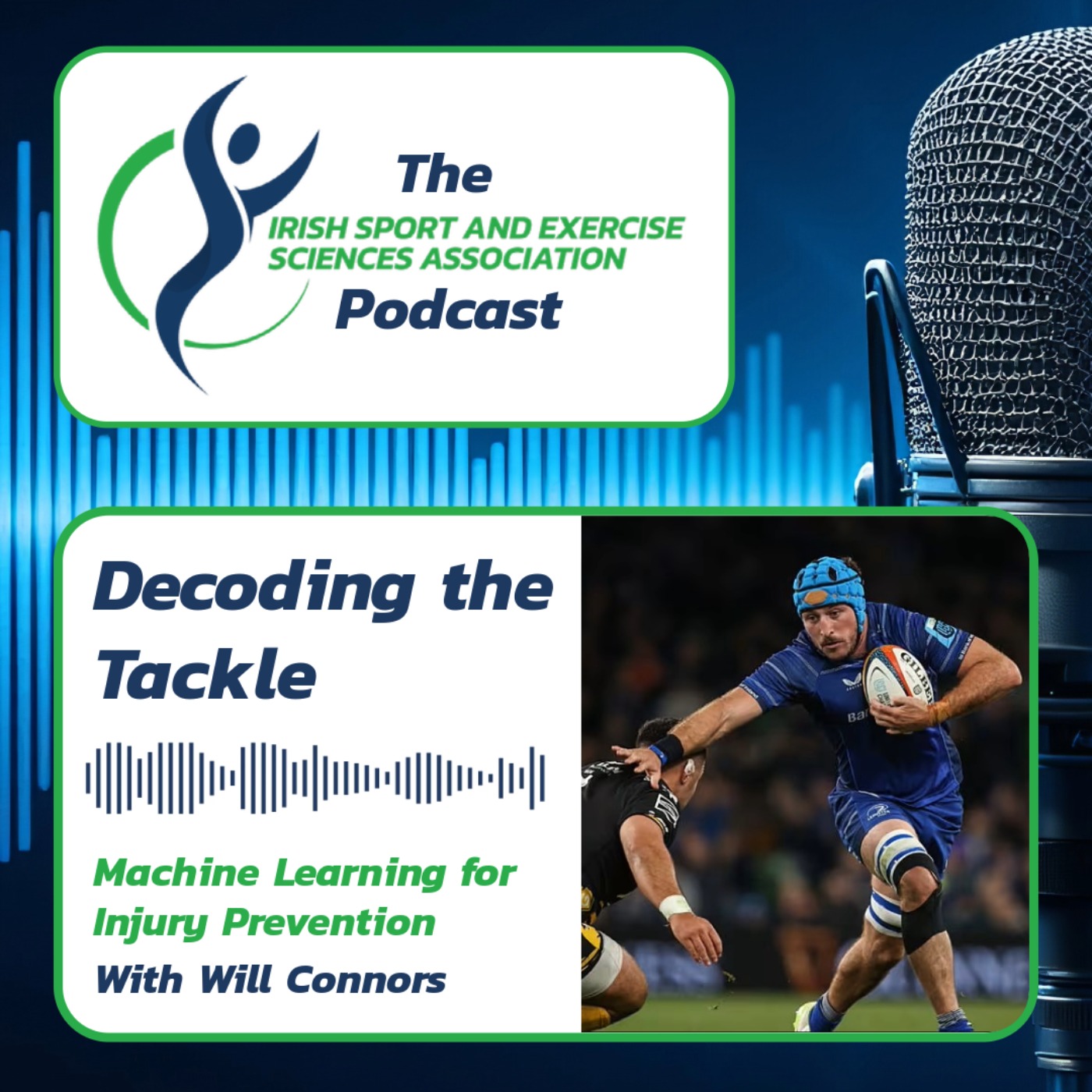
In this episode of the ISESA Podcast, Bruce Wardrop sits down with Irish international rugby player and sport science researcher, Will Connors.
Widely regarded as one of the most effective tacklers on the pitch thanks to his mastery of the “chop tackle,” Will operates at the exact intersection of elite athletic performance and cutting-edge science. After nine highly successful years with Leinster, Will discusses his upcoming move to Connacht, reuniting with Head Coach Stuart Lancaster, and the tactical evolutions he hopes to bring out West. Beyond the pitch, Will is a PhD researcher at Trinity College Dublin. We dive into his fascinating work using computer science, machine learning, and artificial intelligence to map the biomechanics of the tackle. Will explains the massive challenge of teaching an algorithm to identify safe tackle execution amidst the chaos of a professional match, and how this data can ultimately be used to improve player welfare and reduce concussion risks.
Hosted on Acast. See acast.com/privacy for more information.
Irish Sport and Exercise Science Association Podcast
Season 03, Episode 11: “Deconding the Tackle. Rugby & Research with Will Connors”
Host: Bruce Wardrop Guest: Will Connors
Bruce Wardrop: Hello and welcome to the latest episode of the Irish Sport and Exercise Science Association podcast. I’m your host, Bruce Wardrop, and today we have an episode that perfectly encapsulates the intersection of elite athletic performance and cutting edge sports science research. Yesterday evening, I was extremely fortunate to catch up with Irish rugby player Will Connors. If you’re a fan of rugby, you probably already know Will. He is widely regarded as one of the most effective defenders in the professional game. Specifically known for his mastery of the chop tackle, a defensive technique that consistently halts the momentum of ball carriers, felling them like he’s on overtime for Coillte.
After nine successful years at Leinster, Will recently made headlines with the announcement that he will be heading west next season to join Connacht alongside teammate Kieron Frawley, where they will reunite in Galway under their former Leinster coach, Stuart Lancaster. But there’s a whole other side to Will’s career that makes him a fascinating guest. Off the pitch, Will is a PhD researcher at Trinity College Dublin, operating at the forefront of computer science and machine learning while intersecting with sport and exercise science. His research focuses on using artificial intelligence and computer vision to map the biomechanics of the tackle, with the ultimate goal of improving player welfare and reducing the risks of concussion in the sport.
In this episode, we explore both sides of his dual career. We break down the actual mechanics of his famous chop tackle, discussing how a long term injury early in his career actually served as the catalyst for perfecting his technique through painstaking, low level pad drills with contact skills coach Hugh Hogan. We then bridged the gap between the pitch and the PhD. Will explains the fascinating challenge of trying to teach an AI algorithm what an optimal tackle looks like, so he can tease out what happens during suboptimal contacts. And then we discuss how this kind of massive data analysis can eventually be translated into practical, digestible coaching cues for players, making them more effective defenders and simultaneously reducing their risk of injury. I really enjoyed this one. Here is my conversation with Will Connors.
Okay, Will, how are you doing? Will, you’re very welcome to the podcast this evening.
Will Connors: Thank you very much for having me, Bruce. Looking forward to the chat now.
Bruce Wardrop: No, it’s my pleasure. I know we were talking briefly there. It has been hard to tie down a time that we could both agree on. But, you know, you are a busy man. You’ve had a lot of news recently. You’re making a move. Tell us a little bit about that.
Will Connors: Yeah. No, I’ve decided to move west next season, so I’ve been involved with Leinster now for the last nine years. So, yeah, it was a big decision, but like, look, I’ve worked with Stuart Lancaster before, loved the kind of division they’re working with at the moment. Brand new stadium. You know, it’s an exciting opportunity. So it kind of, it was a difficult one to look away from. So I’m really looking forward to that move. And yeah, look, it’s still a lot of rugby to be played in Leinster, but looking forward to the opportunity next year as well.
Bruce Wardrop: Yeah. You mentioned that Stu Lancaster there. I know he obviously played under him before and now you’re going back to play under him again. And I know I think I read a quote that you said that working with him before he gave you a lot of confidence in your game. So are you looking forward to getting back and working with him again?
Will Connors: Yeah, definitely. I think Stu, as a coach, he’s incredibly impressive. Particularly around like the rugby stuff. He’s very diligent in, I suppose, catch-pass, the kind of basic skills of the game, which obviously every coach is. He probably was the first person I really experienced that with. And I just had a good relationship with him. I suppose, even from a personal point of view as well, he is very big on growing not just players, but people, I think, which is probably something we’ve spoken about before. But I think he takes players and if he sees leadership in them, if he sees any bit of kind of growth in them as a person, he’s very good at being able to bring that to the fore. And yeah, like he creates a really exciting environment with that. You know, you’re bringing a lot of new voices to the table. People feel really empowered. And I think from that level as well, it’s an exciting move.
Bruce Wardrop: I know that you’re obviously very well known for your defensive capabilities, and we’ll certainly circle back to that. But I think again, other quotes I read from you about you looking to work on maybe your offensive and your ball carrying ability. And Stu, I saw quoted as well saying that he really sees that ability in you. So, how do you see yourself developing? What are you trying to work on there?
Will Connors: Yeah, like, and I think it’s as a player, I like a kind of routine of working on things like catch-pass, working on catching the ball and working on footwork and kind of seeing I suppose something to be able to follow that. I suppose you find the final results. And so I always felt that area of the game for me with Stuart kind of worked well, like running a line early, bringing footwork to the line. And a lot of it kind of is around just working hard, kind of trying to outwork other teams. So, that was all stuff I really enjoyed my time with him in Leinster and you know, I think even the experience with new coaches and stuff here has definitely grown my game. And that’s why I suppose bringing that, what I’ve kind of grown in the last while as well as going back to hammering down the basics and kind of working hard at that part of my game is definitely something I’m excited for.
Bruce Wardrop: And you’re not making the move on your own. One of the other lads is going with you too. Are you planning on getting a house share or anything like that?
Will Connors: Yeah. Myself and Frawley. So we’re living in the same estate for I’d say four or five years in Leinster. So we had a good bunch of us in there. So I’ve always been very close to Frawley. So, we’ve decided, yeah, we’re going to move in together for the first year anyway, which is exciting.
Bruce Wardrop: You know, I was only joking. I didn’t realize you actually are moving in together, which is funny.
Will Connors: I feel like I’m going into my thirties and I’m moving back in with the lads. So, it’s funny, but no, it should be somewhat good crack.
Bruce Wardrop: Yeah, yeah. And I, like you say it’s a big move leaving Leinster and moving into a new team. I suppose it might make it like that transition just a little bit easier having—I’m sure there’s familiar faces over there in Connacht, but bringing a familiar face with you might ease the transition a little bit.
Will Connors: Yeah, definitely. And like, look, it’s moving away from Leinster, I think is something that’s incredibly difficult as well. It is probably something—I’ve been there for such a long time now. It’s not really a job. I suppose it’s become my whole life. It’s become everything I’ve known, you know. I see people like Leo and Jack and coaches like this. I see them more than I see my parents, you know, which is fine. You’re in there so much. You’re so invested in the environment. So, you know, I think the—there’s the excitement, I suppose, of moving west, but there’s also the ultimate feeling of cherishing the days as they kind of come to an end. And knowing that it’s all finite at this stage in Leinster is sad. But it’s also exciting as well because I think it means like every day you’re in there, you know that it’s like, look, you may as well give it everything you have. Like trying to push for getting a double this year, trying to be involved in every team you can be is also a challenge in itself, but it’s also exciting. And with the excitement of going west and the end of Leinster, it’s a funny period, but you know I’m taking every day, every day with a bit of joy.
Bruce Wardrop: Good, good. I’m glad to hear that. Well like let’s dig into to your game a little bit more. So I said earlier on, and I’m sure some of the people who listen will be familiar with your game, but I’m sure all equally, there might be some people who are not familiar with it, but you are pretty well known for your defensive capabilities. And specifically, I’m not sure if this is the official title or not—is it the Will Connors chop tackle as it’s known internationally?
Will Connors: Yeah. No, and that’s I think it’s probably I’ve become renowned for it, which is something I’ve worked to put a lot of time into and I work out a lot. And, you know, I think to bring that to a team is something I take a lot of pride in. I also like to bring other parts of my game to the field. But like that is probably, I suppose over the years, what I’ve probably been known for most is the chop tackle.
Bruce Wardrop: Yeah. No, I’m certainly not trying to minimize your game to one particular thing. But I feel that it’s going to lead us into on a nice story here. So tell us about the evolution of that. I know that you’ve actually already hinted that you enjoy putting a lot of work into the basics, but I believe it was following an injury that you were limited, maybe in the type of work that you could do. And that led you on to working with a coach, breaking down the tackle technique there into great detail and drilling it and drilling it and drilling us. Tell me that story.
Will Connors: Yeah. So like, it was the time I was coming back from my ACL. When I even think back at injuries at this stage, I’ve had a number of big injuries. So it’s been—I’m trying to think what was my first one. I think it was my ACL and it was coming back from—but Hugh Hogan at the time he was a contact skills coach at Leinster and he was kind of dipping his toes into the academic side of the game. And there’d been a huge amount of kind of work done from people like Sharief Hendricks at the time around the tackle framework. And it was something that Hugh Hogan, I suppose, started looking into more. So essentially taking the tackle and looking at it from not just the single point of tackle, but looking at it from three different approaches to pre-contact to contact, post-contact, and I suppose breaking down the skill at each point. So like the pre-contact, the footwork into the tackle, how close you plant your foot. All these like small little, small little areas of it, but ultimately led to the big picture tackle.
So he, I suppose brought together for me a lot of drills that at first I was doing with him, because I was limited in what I could do—a lot of footwork things and practicing my footwork. And it was almost like to compare it to something like dancing, you know, you’re kind of practicing like bring your feet forward, bring your feet back. And it was very basic, but he kind of kept drilling with me. We were doing it all the time. So then as we started building it up to phases and we started bringing the contact level into it and focusing on the drop and the different areas of that, I started to feel oh, this feels better than I did feel before. And then ultimately, when I went onto the pitch, it probably was a part of my game that had gone beyond where it had been before. Probably something I felt like I was good at. I brought a lot of defensive pressure initially, but now I really honed down on a skill that I probably previous to it, didn’t really think I was able to. I didn’t look at the tackle as such a multifaceted kind of technical skill.
And I suppose Hugh Hogan kind of opened my eyes to it. The fact that he probably broke it down across different areas, small little portions of it, and without me knowing it at the time, he was kind of coaching it into me. And, you know, it was really effective for me. And yeah, no, it was definitely something I’m very grateful for. Hugh brought to my attention and worked on me with—whether I was a guinea pig to it all or not, but it was definitely beneficial to me.
Bruce Wardrop: It is a very, very long time since I played rugby, but I remember playing schools rugby and one specific memory I have is the first time going out. I think I was a transition year, going out and playing a bit of senior rugby, and they bigger guys just lined up against us and ran at us and we were just told to try and take them down and it was really just try and get in as low as possible. But almost falling back is what we were shown how to do—told to do—but that’s not really representative of what goes on in an actual game or what you’re trying to do in a game. If you were to describe now a perfect chop tackle, how does it, how would it run? How would it go?
Will Connors: For me, I suppose, kind of sighting the target early. So you being initially in control. So if you see someone catching a ball and that general shape, maybe they’re ten meters away from you. First of all, you’re sighting them, you’re seeing where they’re coming. So then you take quite an aggressive angle at them and initially your feet—I’m breaking this right down just because that’s what I want you to do. I suppose initially you might as the ball’s in the air, your strides would be quite long as in your natural running pattern. But once they catch the ball, I feel like you bring in this kind of chopping pattern. So your feet come into a lot shorter step so you can kind of adjust any footwork.
So once that point comes, then I think about, okay, how close can I get to him while staying upright? So I’ll come into that position. If I’m tackling off my left shoulder, I’ll think about everything is going through my left leg. So I’m thinking, how close can I get my left leg to his body or to his space, and how quickly can I go from upright down low? And I suppose ultimately bring a bit of a shock factor to it, because I think if you come into it and you’re bent real low and you’re going in at a really low trajectory from very early on, you shoot out from far out, I suppose you can just step away from it. So to me, the perfect chop tackle is the element of surprise as well as I suppose you being in control of the whole movement so that he is probably just caught off guard. He kind of ultimately—you’re hitting him at a point. Doesn’t necessarily have to be lower than the hips, it might be on the hip, whatever it is. But for me, the thing that wins it for me is probably that plant foot and that shock factor or that element of surprise. And when—and then of course, you clamp tight, ideally around both legs from that.
Bruce Wardrop: So yeah, I think what I’m hearing you say there is there’s a lot going on in the pre-contact. You are trying to make sure you’re the one dominating the contact, not the ball carrier coming into you.
Will Connors: Exactly. And I think even when I look at the game from an underage level and from, you know, if I was chatting to a kid, I’d just—not that I’m saying go around flying into lads and it probably looks like you’re a kamikaze in some sorts, and I wouldn’t be advising people to go chop tackling—but I suppose in the game of rugby, you become somewhat vulnerable when you are, you know, if someone’s running at you and you’re tackling. But you’re kind of—I suppose—shine out of it or you feel like that’s when you’re leaving it in the control of the ball carrier and they can run over you. And that’s where you see the risk of injuries and stuff. It’s where you’re probably able to bring your element of control to it as a defender is probably where I see a huge amount of the safety element of it. And you know, then you’re not leaving it out to things that are out of your control.
Bruce Wardrop: I don’t know whether you’ve seen it or not. There’s a nice highlight reel of you doing drop tackles on YouTube. I watched it earlier on today, but one of the things that stood out for me from the video was like, obviously, you know, it’s a selection of really good tackles, obviously. But yeah, speed, you close down the distance to the player, it seems to me like a lot of the impact—I don’t know, is the impact as great with the way you’re positioning yourself? Do you feel like there’s perhaps—how am I saying this—like, you know, if you’re going into a, if you’re hitting someone more upright and torso to torso, I imagine the impact is going to be greater. But if you’re taking them down very low, their center of mass is generally going to be a bit above you. Does that take some of the impact out of it for you?
Will Connors: Yeah. Like, and I think that is probably it. That’s why when you’re coming at a—why people probably talk about lowering the tacklers. I suppose it reduces the chance of you being closer to the head, but also you’re reducing the mass that you’re hitting. I suppose you’re bringing it down a level like when you take from above the hips to the sternum—as you move up that part of the body, there’s a lot more mass that you have to deal with, a lot more mass you have to control. So as you bring it lower, you’re probably bringing gravity into the game a little bit. And once you knock them off that kind of center of gravity, you’re probably in control in that part of it.
Bruce Wardrop: Yeah. And what really stood out to me then after it from that highlight reel that I saw was the your body position when you come out of the tackle. So in the post-contact, you are able to get up so quickly and get back into the action again, where you’re not caught up with a fellow lying on top of you or or other players coming in. You’re in. A lot of the times the tackle was successful, you almost seem to pivot around them, but then you’re up and back into play again. Is that something you notice or you’re aware of?
Will Connors: Yeah, and it’s probably something I, from my own skill development, have fallen off a small bit. It’s probably something I would have would measure myself on. It’s something I’m trying to build back up is—I suppose you’re taking your momentum and you’re using that to bring you up. So it’s nearly like a single movement. You’re still executing the tackle, but you’re using that momentum to probably end that body to guide you back up and plant on the ball. You see a lot with people when they might swing around the tackle and it’s in those instances where people see people swinging, it’s probably not as much of a tackle, but it’s like you can see how momentum can play into your hand if you use it well. So it was always something I probably tagged on to the back of it that that post-contact was like—once the tackle is made, once I’ve clamped on—how quickly can I get back into the breakdown? How quickly can I compete for the ball again? Or how quickly can I just readjust into the line? And it’s probably something that I do try to work on and try to push myself in.
Bruce Wardrop: Yeah, it was really evident. Like I said, I know the highlight of successful tackles, but it was really evident there. Like you said, it was almost, almost like a very fluid movement, pre-contact, contact. And in the post-contact period that you use that momentum to get yourself up and back into play again. Very, very effective, very impressive.
Will Connors: Thank you. Now, so again, like I said, it’s never a—like you get better at some things and some other parts of it fall off. So it’s trying to always keep practicing it and keep, I suppose, constantly improving at it because you know, it’s not something that you just ultimately become the master to. It’s you’re always, always trying to improve and always trying to keep on top of the skills.
Bruce Wardrop: So, um, you’ve also—right. So the reason we’re talking about this then is, you know, your defensive capabilities that chop tackle. And what I’m leading into then is that you have kind of integrated your dual careers: your playing career on the pitch and then your research career off the pitch. Tell us a little bit about the PhD that you’re doing.
Will Connors: Yeah. So my whole background, my undergrad was in computer science. So I did that in UCD. And I suppose I started working initially, my second or third year in college, I got the opportunity to kind of work with my GPS data and trying to see was there any connection between me doing my ACL and my GPS reports over the number of months before? And obviously there wasn’t; I didn’t have the appropriate data or anything to measure it like, but I just wanted to more work with a data set that was sports related? And even though I didn’t get any signal out of it that was in any way leading towards the actual injury, I just found it quite interesting to work with that kind of sports data.
So when I finished up in college, I went and did a year in Kitman. Kevin McLaughlin, who was a former Leinster player, set me up at the time and gave me the opportunity to work in the data science team in Kitman. And I was kind of doing maybe a day a week and it was more just to experience what the teams were like. I was working on a bit of a database of rugby Opta data that I was kind of working around with. But again, it kind of sparked my interest in tying rugby into it. So when I finished up in Kitman, I was like, I kind of wasn’t really sure what I wanted to do next. I met a previous lecturer at the time that I had in UCD and he brought my attention to it—he was like, “Oh, like a PhD. Was there anything you were interested in? Maybe? Have a think about it”.
And then I suppose I started thinking around like the tackle and I’d seen a lot of stuff around at the time, computer vision and how that was being used in basketball and different sports. And I just thought, okay, well, look, I think there could be something in this for rugby, especially around the tackle. So yeah, he gave me an opportunity to do that and you know, like, I look at it now and he took a lot of trust in me bringing this kind of PhD to him. And like it’s been something that’s just kept on growing and growing. And he’s been so helpful. And I’ve got a great lab there that I love working with. But I’m fascinated.
Essentially, I suppose at the time I didn’t really understand how quickly computer vision and I suppose AI moved. And this was four or five years ago. And when I look back, my work then to now it’s just chalk and cheese. But essentially what I wanted to look at—the whole thesis was taking the tackle and trying to run, I suppose it’s called pose estimation, trying to run a skeletal drawing over the tackler. And take that information and see what I can generate from that. So how much information can I develop—how close that plant foot is? Can I develop chopping of the feet? All these things that I learned from the framework? Could I essentially bring this framework that Sharief Hendricks and all these experts have been working on? And can I implement that from a computer vision?
And so that’s kind of what I came into the idea with—how to focus on the skill. So that’s what I’ve been working on the last three years. And, you know, I’m at a pretty exciting point now where I’ve kind of gotten to that point. I’m getting pretty good results on actually being able to dissect a tackle from a framework point of view. And then I suppose the next point of that will be ultimately looking at a long, a much larger set of tackles. So like, say, for example, I don’t know if you took a hundred of what maybe Will Connors thinks from his eye is the best tackles—you take those tackles, you run them through the system. Is that—what does the computer model pick up? Does it pick up that, well, I suppose the prevailing characteristic in all this is his head’s always on the correct side. There’s always a tilt of whatever, sixty degrees, or his plant foot is however far out. And I suppose it’s to try and tie in what parts of that kind of framework ultimately tie into what experts are trying to diagnose the cause and then look at it from the suboptimal end. What bad tackles—what do they have in common? So my whole PhD, in short, was to somewhat be able to use computer vision to characterize and to take information from tackles from a video point of view. And you know, I explained it here now, but I obviously have four years—three years of knowledge that, to me, I’m kind of given a pretty grand synopsis, but I’d say to to someone now they’re like, “What is he talking about?” But look, if anyone ever wants to find out more, let me know.
Bruce Wardrop: Well, so what I’m imagining—first up, I’m going to ask you like computer vision, right? You tell me what that is. Give me a quick synopsis of computer vision.
Will Connors: Okay, so computer vision is essentially like an element of AI, artificial intelligence. So computer vision is you take a video—a video is just multiple images tied together. So you take that video, you break it down into those multiple images, you take that image and you put it into your computer and then you run over a model that as we look at this image, it’s like what I see is your face. So the computer model is essentially like taking all those pixels that make up your face and it’ll tell you, “Okay, well, as I look at this Bruce, I’m eighty-five percent sure that’s a human face”. So you take that for a whole body. It’s like, “I’m ninety-five percent sure that’s the knee of a human”. So you put a little dot on that. Yeah, one hundred percent sure that someone’s ankle, and you build it up the whole body. So eventually you have this little skeleton of information—the stickman—a little stickman. Exactly.
And that information is all—I suppose it gives you degrees. It gives you—you take that stickman, you take the other stickman, which is the ball carrier. And now all of a sudden, you have so much information here that you can kind of pull that visually we can see. But you have to break that down to such simpler form for a computer. You have to give it a rules and how to be able to track that.
Bruce Wardrop: And do you have to manage—at the start of this process, did you have to manually take frame by frame and pinpoint right ankle, knee, hip, elbow, shoulder, all those just to give it the outline of what the body was and then learn from that?
Will Connors: Yeah. And that’s probably where I say from the first year to the fourth year is like, you know, my first kind of two years is a huge amount of not really basic stuff. You know, feeding my computer this information that it learns from. And then from that you kind of test it. And the whole start of my whole process was doing that. And then like, even when I—like the very first paper I wrote—it looked at again that whole system that I talked about, taking a face. But like when I ran this kind of—it would be object detection over a tackle—it would think people are dogs because they’re on all fours. And I had to.
So like from a technical point of view, it’s—that’s probably where trying to bridge—and it’s probably something in time I struggle with is trying to be able to explain or bridge the gap in kind of the computer element of it to the more rugby related bits. And that’s probably where I’m trying to grow my experience in it is like—how can I use this information and how can I bring this probably to the knowledge more of kind of rugby experts.
Bruce Wardrop: So yeah, what would say in an ideal world, what would you like your research to translate into? Is it going to be something to do for coaches? Is it going to be from a safety perspective? What area, how do you think it’s going to impact the game or how would you like it to impact the game?
Will Connors: Yeah. Like, and I think when you start out, everyone has huge ambitions of being able to—their PhD is going to solve the world. And I think as any PhD experience goes, there’s the ups and downs of it. And at this point, I am well on track. But like, I think in terms of, I would love to be able to deliver information around safety. I think is something that I’d like to impact the game in some element to. So like probably try to diagnose what does a suboptimal tackle look like? And I suppose when you do that, you’re able to probably identify what is an optimal tackle—what’s the best version of that?
So from a coaching position as well, I think ultimately there’s a lot of different avenues I can go down. But just the way the game is—the way the negative sentiment around the tackle and you hear people call out for the tackling the game to be removed. You know, it is probably one of the most exciting parts of the game. It’s that kind of contact element is part of the game that—the gladiatorial element of it really, isn’t it? Exactly. And it’s like without that—without the tackle—it’s like it’s hard to see how rugby would be played or how you—I suppose—because there’s already a game of touch. So then it’d become essentially touch rugby. But to me, I feel like there’s probably a lot of different aspects to the tackle that you can coach. But it is all coachable and there is a lot to be gained from it. From my own experience. You know, I started out not knowing anything about any of this. And then through Hugh Hogan, I got to see the impact of it. So for me, I think being able to—I suppose—give other players or from any age that experience is probably something I’d enjoy.
Bruce Wardrop: So just as you brought it up there, you know, you say the rugby and the tackle had a bit of a bad rep recently. Talk us through some of the changes that have been made around tackle height. And I know at the underage level it’s a little bit different. Is that something you’re familiar with?
Will Connors: Yeah. And like obviously bringing the tackle height down lower. There’s been that head to head risk. Exactly, exactly. And there’s also people then come on the other end and say, you know, head on hip is quite impactful as well. But that’s not where they’re trying to move to. They’re trying to—I suppose—bring the tackle again—if it’s not a controlled skill, it can be dangerous in any way you deliver it. So I do feel like when you bring the tackle height down—and there has been across definitely women’s rugby, there has been evidence of it—their reduced amount of head impacts. So there obviously is a lot to support that part of the game and like their—like World Rugby are constantly trying to find different ways to make the game safer.
And you know, like you look at the scrum ten years ago—maybe fifteen years ago—it was such a dangerous part of the game. You know, there were spinal injuries across amateur rugby, people paralyzed, and they worked a lot. And what seems like subtle changes was so impactful on the safety of the game. And I feel like the tackle in its own way, will find that kind of gradual change that—you know—it doesn’t feel like as we bring down the tackle height or as we find different parts of the game to maybe minimize the risk of head injuries or head contacts, there definitely will be growth in the safety side of it. I think it’s just somewhat in the early stages of getting to that point.
Bruce Wardrop: Yeah, I think the scrum is a good example. There was—when they were trying to introduce those changes gradually and bit by bit. It’s always a bit turbulent when there’s changes introduced anywhere, and particularly in a sport where people are particularly passionate about what’s going on. But now it’s—they’ve come out the other side of that. The scrum is relatively safe—well safer—I think it’s safe to say—but a highly contested and highly competitive part of the game now still.
Will Connors: Exactly. And you see how even the scrum is now—you saw South Africa come over to the Aviva and use it as such a powerful part of the game to—I suppose—impose themselves physically in a game. It’s gone from probably something that was a negative part of the game now to something that like you said, teams can maximize. And I suppose you practice more that you get better at it.
Bruce Wardrop: Absolutely. I know that we talked briefly before I hit record there about the schools rugby. I know you’re from Clongowes and unfortunately Clongowes have been put out of senior and junior, both by Mary’s. Tough times. I know my own nephew—shout out to Cameron there if he ever listens to this—also, he was with Terenure there, and they got knocked out of the junior cup. So, if you were—I know you said you did the draw for the senior Cup and do you go back? Are you involved in any of that underage stuff or what would you like to see from a tackle point of view and being coached with those kids?
Will Connors: Yeah. Like I think—without getting incredibly technical—the tackle to optimize that—I bring it to—the safer point is also improving the skill of it. So you’re getting better at it and it’s also become a safer part of your game. So I always feel when I look at—especially younger players in the academy or down at school—whenever I’m working with people in Clongowes—is that when you say to someone to go hit a pad hard, everything they naturally think of is from their upper body—is how they’re going to impact a power in the shot. And you know, they go in and they go with their limbs flailing and they go whacking a pad and it sounds great or whatever, but it’s—I think from my point of view from going through it and even Jack’s name, again, he’s really emphasized to the point that all the power comes through your legs.
Working with—if I’m tackling off my right foot, off my right shoulder, using that right leg as kind of a power stamp essentially, and that everything is coming from there. True. So when you go to hit someone hard or you go to stamp a mark on someone, once you go trying to think, “Oh, I’m gonna whack this lad” and you go flying in with your upper body—you’re out of control. You’re probably putting yourself in somewhat of a risky position. But also it’s probably not as impactful as generating it from the lower body up. So it’s not like—naturally it feels like it should be the other way around. But I think when people experience it and they actually get a proper—they start working with that kind of method—it definitely is probably one of the more impactful things around it.
Bruce Wardrop: Around the time that I found one of the things—again, you’ve just jogged my memory there. I—when I was preparing for this—I think I’m going to get the phrase wrong is this—you know, in that pre-contact phase that you center or balance yourself before—what does that mean? What do you mean by that?
Will Connors: “Come to balance”, I think. “Come to balance”. It’s kind of—again, Catherine Dane—she’s heavily involved around the kind of safety side of and has worked a lot with the women’s game and has done some incredible work around it. She has kind of found that “come to balance”—that idea that when you’re coming to the tackle is that you’re in control essentially. Like I talked about that chopping of your feet—is that you’re able to maneuver yourself quickly to if they step a little bit to the right, if your feet are—I suppose you’re in control, then you can maneuver in time. And then from that—I suppose—being able to bring your body down to which your foot, that plant foot that I’ve talked about. And then again, ultimately you’re in control of the contact.
I think for me is the overriding element of it all is that you’re in control. That “come to balance” is that you’re in control of your body. You’re in control of this scenario. As you’re coming to balance, as you’re coming down, you’re making a tackle, you’re still in control of that whole movement. And her work has found that to be a really important part of it that—when you look at this big framework of tackle stuff—when you look at that, that “come to balance” is probably one of them. Ultimately, that’s probably one of the most important things of it.
Bruce Wardrop: And we’ve gone off on a bit of a tangent. We’ve moved away from your PhD there, but one of the other things I wanted to ask you about was—you mentioned there that the timing of your PhD—I think, did you say you’re about four years into it? And the whole world now knows what AI is. And everyone’s probably familiar with using AI on a day to day basis. I presume you must have been an early adopter to us or must at least been peripherally aware of it back then. And how much has it transformed what you’re doing? Is it progressing and the research side the same as progressing on the commercial side that we’re seeing?
Will Connors: Yeah. And from the research side of it, it definitely progressed massively. There’s no doubt about it. You look at—I suppose—with these models, these pose estimation models that I talked about, these skeletal models—at the start, it probably was different labs kind of developing it. Google probably had a slot in it. But then now you see like Meta have been involved. These models are constantly getting updates every every week, every two weeks. And the updates aren’t just like a few bugs with fixes. It’s kind of like revamping different areas of the model that—I suppose—ultimately makes it much, much more effective. And performance is tenfold better than what it was before.
So like from an academic point of view—when you’re looking at papers, you’re looking at how they used so-and-so and then you’re like, “Oh, well, that even though it was only a year ago, you use this different model”. Ultimately, it’s probably much better performance. And it’s funny how that is just probably just worked in tandem with how—from a business point of view—how profitable that side of the market has been around AI. And these models around pose estimation, object detection—like object detection would be something, again, that I’d use in this tactical stuff, but like that would be used in self-driving cars. So object detection would be—you have a camera at the front—it’s like these models, this kind of object detection model is being used to detect whether that’s a person that’s a child, whatever it is. Obviously as that side of—you see in California—self-driving taxis and stuff—like Elon Musk is involved in these—they’re hiring the smartest people in the world to work on these. And you can understand why they’re obviously constantly improving from not just year on year, from month on month or week on week even.
Bruce Wardrop: I’m letting my head—my mind run away with myself here. We’re obviously not going to have autonomous rugby players, but you know, say if we were—going back ten or fifteen years ago—GPS was maybe something that was used for research, then it became something that was used for training. Now it’s something that’s used in game and decisions are being made. Tactical decisions have been made on GPS data that’s been fed back. How realistic or how far off is it that there could be computer vision based on actual live footage that’s coming from a match?
Will Connors: Yeah. And I suppose again—how well can it be utilized in a game—because that’s the thing—if you, for example, it’s the seventy eight minute in a Champions Cup final and you have—I don’t know—so-and-so kicking from the left hand side and you take all that information. It’s like, “Okay, well, he has a seventy five percent chance of kicking this”. But also they take their restarts, they recollect them on ninety percent of the time. All of a sudden you have all this chance data being used as well as ultimately trying to decide a game, but like how well or how effective can people utilize that again is—it probably will be seen around the coaching side of it in time.
But I think something that is very hard—especially in sports to understand is the environment—like a Champions Cup final. Even though ninety percent of the time a team might regather a kick off—the last minute of a game—a coach probably understands having been in that situation, however long, that in that moment, it’s probably only a ten percent chance they’re going to get it. He knows his team are going to go flying up. And that whole element of the human side of it is probably something that—in time—maybe computer systems will be able to get more involved in. But at the moment, I feel like that human experience is something that coaches have, they have that intuition that ultimately puts them into big jobs.
Bruce Wardrop: Yeah. I noticed you have one of the very popular wrist based performance trackers on there. And you’re reminding me that they give you really good information, Really useful information. But it’s only as good as how well you’re willing to act on it or what are you going to do with that information that comes through to you? I no longer wear mine. I think I wore it for a couple of years. Used to tell me that I’ve had a beer—I wasn’t to go to the gym the next day—but I started to ignore that.
Will Connors: And the thing is like—you could wake up on the day of a game and it could tell you you’re sixty five percent recovered and it’s like, you feel great, but it’s telling you you’re sixty five percent recovered. It’s like, what does that impact you then from the point that you’re like, “Okay, well, geez, I’m only sixty five percent”? All of a sudden you get caught into that placebo or whatever it is, and you probably drop down a level. So it’s like—taking it—being able to take that information with somewhat of a pinch of salt, but also being able to—for me, I just like it for being able to see what I’ve done in a day or track session as well. But do I live my life by it? I try not to.
Bruce Wardrop: It’s not the data scientist in you doesn’t get too obsessed with us.
Will Connors: No. Well, currently not, but again, as they say, there seems to be new features coming out every couple of months. So eventually, maybe I will get completely obsessed with it, but currently not.
Bruce Wardrop: Yeah. And the likes of Stu Lancaster isn’t going to be replaced by AI anytime soon.
Will Connors: No, no. Definitely not.
Bruce Wardrop: Listen. Well, it’s been really fascinating talking to you. Like really, really enjoyed it. Thank you very much once again for taking the time. Best of luck with the remainder of the season with Leinster and even better wishes for your move to Connacht.
Will Connors: I really appreciate it and thanks for listening to all that. Sorry if I went off on tangents talking about—
Bruce Wardrop: Absolutely not. No, I was fully engaged and fascinated the whole time.
Will Connors: No, I appreciate that. Thank you very much.
Bruce Wardrop: And I’m back. Will was a thoroughly engaging guest. He was really friendly and just a pleasure to chat with. I’m not surprised when I read about his move to Connacht and see Stu Lancaster commenting that he views Will as a very positive personality, who’s going to bring great energy to their squad and has real potential as a leader. Connacht are going through a rebuilding phase and I’m sure injecting highly professional, culturally positive characters like Will will provide value on and off the pitch.
One thing that didn’t come up in our conversation was coffee. My understanding is that Will is a bit of a coffee aficionado and entrepreneur starting out as Johnny Sexton’s coffee boy. He is now involved in Typo Coffee, who have three locations across Leinster and I’m guessing maybe soon in Connacht. Okay, that’s it for today. If you enjoyed the episode, please give it a share online and leave us a comment or a review that really helps to gain the old algorithm and expand our audience. Thanks for listening. Catch you in the next one.