
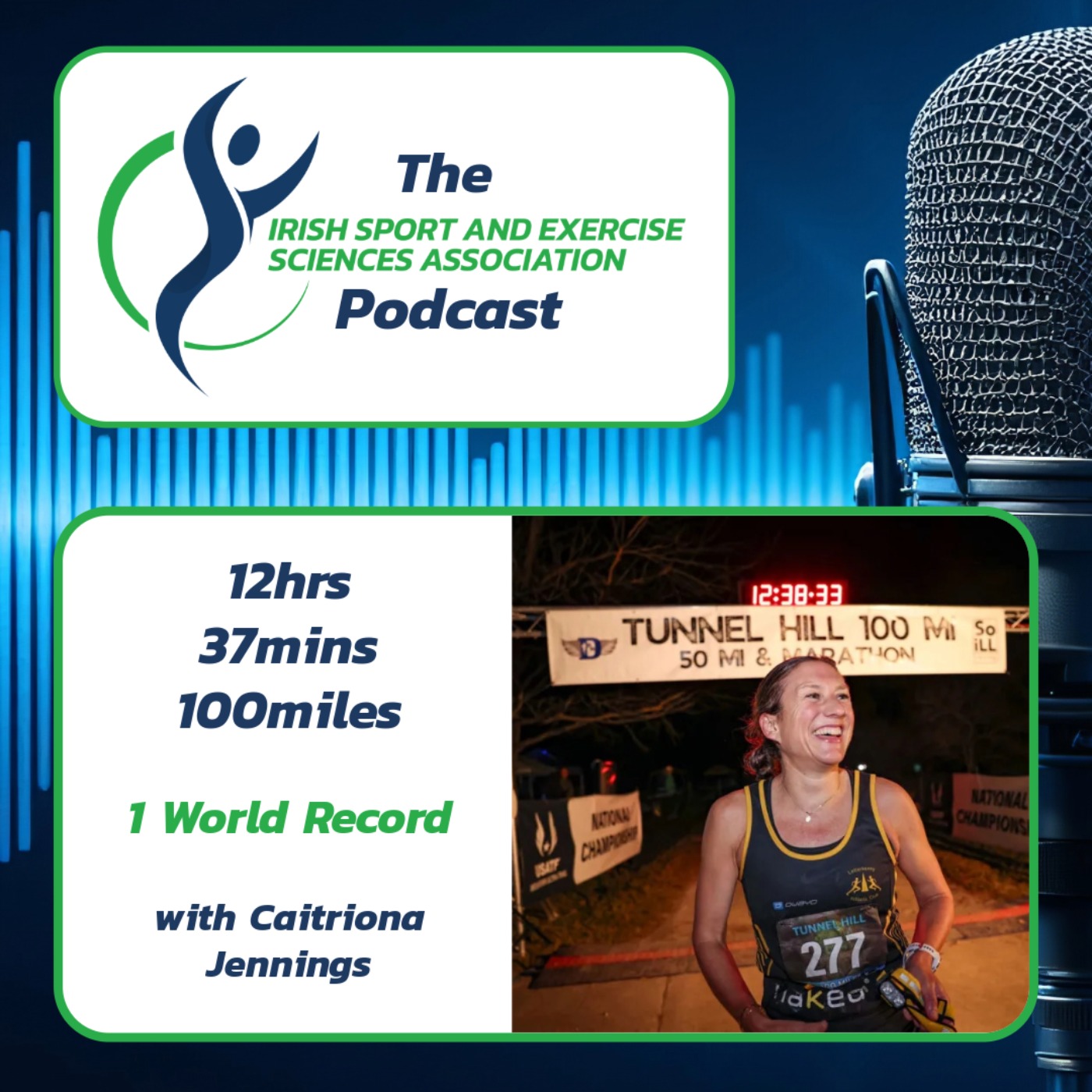
Most of us would struggle to drive a car for 12.5 hours without losing concentration. Caitriona Jennings ran for that long—averaging a blistering 7:34/mile pace to shatter the 100-mile World Record. In this episode, Bruce sits down with the 2012 Olympian and new ISESA board member to discuss one of the most remarkable feats in Irish endurance history. We explore how she balances her C Suite role (Vice President in Aircraft Trading) with elite ultra-running, often flying straight from a race finish line back to the office. We also revisit the heartbreak of London 2012, discussing how finishing last on a stress fracture became the foundation for the mental steel required to excel in the ultra-running world.
Key Topics Discussed:
- The World Record: Breaking down the 12:37:04 run at Tunnel Hill—pacing strategy, fueling with high-carb gels, and the mental battle of the “figure of eight” course
- The “Dual Career”: How Caitriona manages 100-mile training weeks while holding down a high-pressure corporate role in aviation leasing
- Resilience: Why the trauma of London 2012 ultimately prolonged her career and prepared her for the pain cave of ultra-running
- Training Philosophy: How a mature athlete manages volume, avoids injury, and uses the weekend for “compounding” long runs
- What’s Next: The hunt for the “Green Number” at the Comrades Marathon 2026.
Links & Resources:
Register for our January Webinar
Hosted on Acast. See acast.com/privacy for more information.
ISESA S03E07 Caitriona Jennings
Bruce: Hello and welcome back to the latest episode of the Irish Sport and Exercise Science Association podcast. I’m your host, Bruce Wardrop, and my guest today is someone who genuinely redefines the concept of endurance. Most of us might struggle to, I don’t know, drive a car or do anything for twelve and a half hours straight without losing concentration. Caitriona Jennings ran for that long. And she didn’t just run. She averaged seven minutes and thirty-four seconds per mile for one hundred miles to shatter the world record at the Tunnel Hill 100 race back in November.
To put that into context for you, that’s the same as running back-to-back marathons in a row without stopping, each coming in at around three hours and seventeen minutes. Absolutely phenomenal running. But Caitriona isn’t just an elite ultra-runner. She’s also a 2012 Olympian who represented Ireland in the marathon, and in her spare time she works as the Vice President of Aircraft Trading at the Aviation Capital Group. Don’t worry, we explain what that all means during the episode.
We also hear about Caitriona’s recent world record in detail, and we dive into the mindset that’s required to push your body to the absolute limit while holding down a demanding corporate career. We discuss her London 2012 story, how a stress fracture and a last place finish in the Olympics became the foundation for her resilience and the springboard into her ultra-running career. We also explore her new strategic role on the board of the Irish Sport and Exercise Science Association. So whether you’re a runner, a practitioner or just someone who’s trying to fit it all in, this conversation is a fascinating insight into discipline and grit. I really enjoyed this one. Here is my chat with Caitriona Jennings.
Bruce: Caitriona, good morning. Thank you very much for joining me on the podcast today.
Caitriona: Thanks, Bruce. Delighted to be here.
Bruce: It is unusual. We’re recording early in the morning. So tell me, what has your morning looked like so far?
Caitriona: So, a quick cup of coffee, run to work, and just get to the desk and start the day.
Bruce: So is that run to work part of your training, or is that just something that you enjoy doing?
Caitriona: It’s part of my training, to be honest. It’s the easiest way for me to get my training in time-wise. I do work a full-time job and it can be long days, particularly because the company that I work for is headquartered in the US and can often drag into the evening. So I like to try and make sure that I have my training done in the morning or at lunchtime, so that I don’t feel under pressure to train in the evening when I may have to join late calls and the evening goes askew that way.
Bruce: Yeah, the stuff gets in the way. I’m not a morning person. I hate getting up in the morning, but I do get up in the morning to do my own training as well. Because like that, the rest of the day it’s kind of hanging over you. Something that needs to be done. And inevitably something either gets in the way or it gets in the way of something else.
Caitriona: Exactly. And it’s easier to find an excuse as the day goes on. Whereas when you jump out of bed and start, it’s just your routine. And I think it’s easier. It’s also a really nice way to start the day. I must say, I ran in this morning. I run along the coast, and it was one of those beautiful, very cold but sunny mornings here in Dublin. And yeah, it was one of those days that once you actually see it, it always kind of lifts you and puts you in good form for the day.
Bruce: Maybe that’s just the caffeine kicking in as well.
Caitriona: Possibly.
Bruce: So I’m curious then also so what what what type of distance are we talking? What’s the run to work?
Caitriona: This morning was eight miles. I would sometimes do longer. It depends on a couple of things. Mainly time, which is unfortunate in some respects, but the weekdays sometimes are just condensed, shorter runs because I do try and do a lot of my training at the weekends. On Saturday and Sunday when I have more time, I’ll do the bulk of my mileage. Well, not necessarily the bulk, but oftentimes I could do maybe up to fifty percent of my weekly mileage on Saturday and Sunday, which I wouldn’t necessarily recommend to other people and particularly to novice runners.
But for me, it’s the best way I can just get the training in during the week, given my other commitments. And I think from the point of view of an Ultra-runner, it actually works quite well because you get the compounding effect of those two long runs on Saturday and Sunday, which definitely helps when it comes to the race. And obviously we know you never run the full distance of the race prior to running it, but being able to run two long runs back to back like that over the weekend is probably as close as you’re going to get.
Bruce: So yeah, for those who may not be familiar, even though you were significantly in the press prior to Christmas, you broke the 100-mile race record over in Tunnel Hill. So you ran 100 miles in 12 hours, 37 minutes and 4 seconds. Have I got that correct?
Caitriona: That’s right. Yes.
Bruce: Okay. So, you started out as a marathon runner and you have upscaled it to ultra distances. So tell us a little about that. Can you set the scene for us? Tell us about the Tunnel Hill 100-mile race itself. What is it? Where is it? When is it? What’s the course like?
Caitriona: So the Tunnel Hill, I think the version I did was the 12th running of the race, and it takes place in Southern Illinois. It’s about five hours south of Chicago by car, and it is run on a converted train track. So it’s quite a nice surface. It’s not road but it’s fairly favorable trail because it’s kind of crushed concrete or something. It runs through a forest, so kind of an idyllic setting. But because it’s an old train track, lots of very long, long stretches. And given that Tunnel Hill itself is… I think the entire field was probably about three hundred people, you are spending a lot of time on your own during the race.
The race is a 100-mile race. It also has a 50-mile race combined. So it’s like a figure of eight. For the 50-mile you do one figure of eight. For the 100-mile you do two figures of eight. So for the first 50 miles, there was probably a few more people on the course. The second 50 miles was quite lonely, particularly the first half of it, from mile 50 to probably about 76 or so. But yeah, it was a race that just went very well for me. And I was delighted to be able to break the world record on it.
Bruce: I love hearing stories about these things. So tell me, what can you recall from the start line that morning? When you conjure up a picture in your head of the start line, what do you remember?
Caitriona: I was incredibly calm and relaxed on the start line of the race, actually. I had spent the night before in the race accommodation for some of the girls that were running. I know them from other international races that I’ve run, so it was really nice to be able to catch up with friends and like-minded people before the race itself. So two of the other girls from the US and I went to the start together. We did a small warm up and there was a really positive atmosphere. I think there was a lot of excitement in the air.
The race was also combined with the USAF 50-mile championships, so that meant that there was quite a bit of nerves in the air too because it was a competitive race. But for me, I had just a very nice confidence about me. And I think that came from having had a really good build up to the race. I had trained incredibly hard. I was really focused on it, and all my training had just gone really well. Kind of exceeded what my expectations would have been at the start of the training block. You always kind of expect for something to go wrong or to go badly for a few weeks of your training, just for various reasons. But for me, on that occasion, everything kind of just went really well, and I just knew that I was in very good shape.
I had done a couple of really good sessions prior. Even during my taper. I was in Chicago for a few days before I went south to Illinois, and I always do a session on a Tuesday before a big race, and I was just really on fire on that Tuesday, and it gave me a lot of confidence. So I really was looking forward to the race when I stood on the start line that morning.
Bruce: It’s funny, that’s not a story that you hear very often. People often describe nerves and anxiety on the start line of a race. So it’s lovely to hear that.
Caitriona: Yeah, it is. Absolutely. And I mean, it’s unusual even for me. I don’t go to races and stand on the start line that confident. And at the time it probably didn’t dawn on me how relaxed and confident I was. But when I look back on it now, I’m like, wow, I was super relaxed. I mean, the thing is that you do need a certain amount of adrenaline before a race as well, because that’s what gets you going and really gives you the extra boost that you need when you’re racing. But maybe for the 100 miles, I didn’t need it. And in fact, the lack of adrenaline may have helped because it helped me to stay very patient at the start and to not get too excited and to get carried away with the 50-mile racers who are girls that I race all the time. And that was challenging in itself to let all those girls just go and leave me behind. But I think that sense of calm probably helped on that occasion.
Bruce: Now I won’t ask you to relive every mile of the 100-mile race as you went through it there, and I’m interested to hear that it was a figure of eight. I thought it was an out-and-back course. I’m just wondering, how do you break up mentally a course like that when you’re approaching such a long distance?
Caitriona: So the way I broke it down was… the first loop was exactly a marathon distance, 26.2 miles. And then the other side of the loop was just under 24, I suppose 23.8 to make it the 50-mile. So in my mind I was breaking it down into the first marathon, then the first 50-mile. Then the 60-mile mark for me was a huge milestone in my head because I had never run more than 60 miles before. 100K or 60 mile run was the longest I’d ever run before the race. So anything from there on was an unknown for me, and I really didn’t know how my body would react, how my legs would hold up, how my head would go.
So that was a big milestone for me. And then the next milestone was just getting to the end of that loop. So that’s 76 miles. And then the final 24, in my mind, was just to, at the start anyway, just try and get through that section. So I actually think the way the course was set up was actually quite nice, in that it gave you the ability to have those milestones very clearly set out, and they were long enough within a very long race that you weren’t having lots and lots of milestones and getting fatigue from just having milestones.
Bruce: So your first milestone was a full marathon, which is no mean feat in itself. I’m wondering, over the course of the race, you averaged about a 7:34 per mile, or 4:42 per kilometer. Pretty quick going. You said now that the adrenaline wasn’t too great at the start, so were you able to successfully manage your pace? Did you have a pacing strategy in mind, or did you just go out and run off feel?
Caitriona: No, I absolutely had a strategy in mind for pace because it was actually a slower pace than even I would usually jog at, so I really had to have a strategy. I decided just given how well training had gone, I decided I was just going to go for it and I would head out at world record pace. So I wanted to try and stay on pace from the start and maintain it throughout. That was my plan.
But when I started, it was very difficult for me to run at that pace. I kept running too fast and then having to try and back off, and then I’d naturally just start running faster again. So I was doing almost like a yo-yo for a while at the start. I’d say for the first five miles it started dawning on me. I was like, I can’t spend the whole race looking at my watch trying to get back on pace. I’m going to have to find a rhythm and a pace here that I can actually just maintain without looking at my watch, because I don’t like really looking at my watch as a guide when I’m running. I do like to run by feel. But on that occasion I had to use it as a tool to help me to actually find what that pace was.
So after about five miles, I thought I had a pace. It was faster than what I had intended to run at, but I just thought, this feels comfortable. My heart rate is low, I feel good. I’ll run at this pace and just see how it goes because the alternative just wasn’t very appealing. I knew at the end of the day I was going to have to enjoy the race as well to some extent. So I just kind of settled in at that pace. And actually that pace felt really, really good for quite a long time during the race.
Bruce: You were able to back yourself. That’s great. So with the pacing strategy in mind and saying that it was slower than usual pace, what led you to that pace? Was it fueling? Fatigue? Lactate?
Caitriona: My rationale for choosing that pace was I just wanted to break the world record. And I thought, okay, I mean, if I’m trying to run it, I’ve never run the distance. I can’t overshoot because who knows, I’ll blow up and then I’ll achieve nothing. Or I can try and run on that pace for as long as I can and hold it for as long as I can. And if I fall off it, then at least I’ll know I tried and failed. So that was my really only strategy for picking that pace.
In terms of fueling, yes, fueling was a huge element, of course, and also an unknown because I knew I could run on gels and carbohydrate drinks alone for a 100K race, but I didn’t know if I could do that for a 100-mile race. I didn’t know if I would need more real food, more solid food, and how my body would react or my gut would react to that constant intake of gels.
I did quite a bit of research before the race, and I ultimately decided to run with the SiS Beta Fuel, which is a higher concentration of carbohydrate for each gel. You get 40 grams of carbohydrate per gel versus about 24-25 in a normal gel. So that was hugely beneficial to be able to take in less liquid but get more carbohydrate. I ended up on the day also adding in Tailwind, because the temperatures got up to about 23 degrees on the day, which I hadn’t expected. And I did need additional electrolytes that I hadn’t really anticipated.
Bruce: Is that something that you would have practiced beforehand? I assume you didn’t use those gels for the first time on race day.
Caitriona: I had used SiS before. No, “do as I say, not as I do.” Of course, I would never recommend it. But I do know my gut is actually… I do have quite a resilient tolerance for any kind of gel. Within reason. I wouldn’t have tried a new brand on the day or anything. I was cautious of… I know the SiS brand really well. I have taken other products in it, and I was fairly confident it would be fine.
Bruce: Yeah, I can recall doing a triathlon many years ago. And I think someone had left free samples of a gel in work, and I brought one with me, and I tried it for the first time in the middle of the race, and I had to hop off the bike and get into a bush and puke my guts up.
Caitriona: You’re not alone. I mean, you should never try a new product during a race. But I was lucky with my one.
Bruce: On breaking the world record and setting out at the marathon pace… so I hope my maths is right here. I think you beat the previous record by five and a half minutes. Five minutes 40 seconds. Which when you say I beat a world record by five minutes and 40 seconds, that sounds like a lot of time. But again, I hope my maths is right here. I reckon it’s less than one percent.
Caitriona: It was about three quarters of a percent. It was tight. It’s close. People say, oh, you had a huge gap. And I never felt that I did. And I think that one tiny thing having gone wrong could easily have eaten up that five minutes very quickly, particularly in the latter part of the race. If you do blow up and you start hemorrhaging time, that five minutes can be eliminated incredibly quickly. So I never really felt that I had a massive gap, but I was always confident enough that I was within the time that I had set myself as well. So I never panicked on the day.
Bruce: Yeah, 0.76% is what I have calculated. So that is really tight. Over five minutes out of twelve and a half hours, it’s not a lot of time. In that latter half of the race, is that where you became more acutely aware of that, or was that something that you were conscious of the entirety of the race?
Caitriona: I won’t lie, I was conscious of it all throughout the race, not in a very front of mind way, in that it was always just there. I was always just making sure I had set out my target times for the various milestones, and I knew I was within it. Every milestone, I knew I was still there and I knew I was fine. So I suppose you have to set it aside as well once you’ve… That can’t be what’s motivating you throughout the whole race or it’s too much pressure. But I think because all my target times were within that goal range, I knew that I was comfortably within it. And actually I was running quite a bit faster than I’d originally intended for the first maybe 75 miles. And then I think for the last 20 to 25 miles, my pace did drop off a bit. But I still knew that I had the buffer, and I knew I had enough of a buffer that was going to get me there.
Bruce: I think I am correct in saying you finished fourth overall in the race?
Caitriona: Yes. That’s right.
Bruce: So what in the closing stages… you mentioned at the start that it was pretty lonely out there on the course. Towards the end and in the closing stages, were there people or were there some of the male competitors around you, could you see them?
Caitriona: Because of the nature of the out-and-back, I could see them at the turn so I could see them coming back to me at the ends of each of the loops. But no. And also because it was November in Illinois, it was dark from 5pm onwards. So 5:15 it was dark and I couldn’t see anyone. All you see is little spotlights. What I was seeing for the latter say 20 miles was people that I was just lapping. They were still on their first lap of the 50-mile section, and then I was passing them to finish my 100 miles. So, you know, it was nice because you’d see something up ahead and you’d pass it so it would distract you. But there was no one, like I basically ran the entire thing on my own. I didn’t have company or I didn’t have someone to share some of the miles with. And I didn’t really have a target because the guys, while I thought maybe I might catch up with them, the only reason I would catch up with them at that point would have been if one of them had kind of blown up. And they were in a race, the three of them were actually racing each other. So they were kind of fairly close together.
Bruce: Listening to you there… it sounds like it was a lonely race. And I’m wondering, you are describing it as if physically it went particularly well, and it must have gone particularly well if you broke the world record. But it can’t have been without challenges, it can’t have been without pain. It can’t have been without some mental moments where you were struggling. So tell us about that. What was difficult for you when you were out there?
Caitriona: Yeah, I would actually say it was more of a mentally challenging race than a physically challenging race, even though I understand that sounds bizarre because you’re talking about running 100 miles. But I think I was very well prepared and I was very comfortable running in the physical sense. From a mental point of view, it was lonely and it was just a constant reaffirmation of positivity in my own head. It was dealing with my own thoughts throughout the entire thing.
I knew there was a high probability that I would run a lot of it on my own, and I prepared for that eventuality. I did quite a bit of visualization and planning for how I would deal with obstacles that might arise. So I think that preparation really stood to me because it certainly was a race that you had to just really zone in and stay focused. Yes, there were miles that just flew by because I was probably in a bit of a flow state for quite a bit of it. But it was trying to maintain that focus in a relaxed way to the best I could.
I actually didn’t really come across any major mental hurdles, to be honest. As I said, I had prepared well and anytime there was any sort of tiny negative voice, I would just be really positive and start reaffirmation that I was feeling good, I was doing well, I was on pace. And I think breaking it up… each aid station was on average about five miles apart. So just seeing my husband who was there to crew for me every five miles, getting the nutrition and focusing on that, changing the diversion a little bit… that was probably just a nice little distraction. But yeah, definitely a tough mental race.
Bruce: So I know that not every race in your career has gone quite as well as that. For those who aren’t familiar with your London 2012 story, could you tell us that? Give us an overview of that story in your own words?
Caitriona: So in the lead up to London, I qualified for the London Olympics in the Rotterdam Marathon that April, and the London Marathon was in August. And in the lead up, I suppose two to three weeks before it, I started getting plantar fasciitis. I fully thought that when I was running on the day, I would be warmed up sufficiently that I wouldn’t really feel it. I get through the race and deal with the consequences afterwards. Unfortunately, that’s not the way it panned out.
I ended up getting a stress fracture of my fifth metatarsal during the race because of compensation. I’m sure it was a build up of having trained on an injury for a few weeks leading into it, and then the actual race itself just kind of put it over the edge. But yeah, unfortunately, I didn’t have the race that I had hoped for or trained for. But I did finish it. And I suppose I showed that resilience and ability to deal with an unfortunate string of events. I just pivoted, dealt with it, and still managed to finish the race.
And looking back on it now, I’m very proud of it. At the time, I was devastated. It was probably my worst nightmare coming true. But as I said, I can really take a lot of positives from that race now and understand that that’s just life. Things don’t go perfectly all the time. No matter how much preparation you do, things go wrong and it’s how you deal with them that matters. And I think particularly in ultra-running, you have to be prepared for absolutely anything and everything going wrong. And I think the experience of knowing that you can actually get through the worst thing that could possibly happen gives me quite a confidence now when I’m racing in ultras. I know that I’m a tough runner and I can deal with things going wrong and I will find a way to get to the end.
Bruce: That’s exactly where I was hoping to pull this thread of the conversation. When I hear your London 2012 story, I think of someone who is very tough mentally and physically and resilient and maybe a bit stubborn as well. For you to have the plantar fasciitis and then to develop a further foot injury and to complete the race… first and foremost that must have been physically very painful, which must also have been mentally very difficult. And then obviously dealing with not meeting your own performance expectations. I’m just wondering… coping with that, dealing with that, recovering from that. Is that what has led you to be a good ultra-runner now?
Caitriona: Yeah. Very possibly. And it was interesting because immediately after the race, of course, I thought the entire thing was an absolute travesty. I couldn’t see anything positive at all. It was really traumatic. And it took me a really long time to actually recover from it mentally. Physically grand, you can do the rehab and get over it, but I couldn’t really think back to the Olympics and think of it in any sort of a positive way.
But one of my close friends that I trained with very closely in the aftermath of London said to me, “You know, now you’re going to be a good ultra-runner because we knew you had the engine, but now we know you have the mental strength.” And at the time I just kind of passed it off. I didn’t pay too much attention to it because I was finding it really difficult to see any positives. But in a way, I think that kind of planted a seed which then ultimately led me to get into the world of ultra-running. And in hindsight now, I’m really grateful to him for planting that seed. And also, he is right. I can see it now myself. Maybe it was just my fate and maybe that was meant to happen for me, because it has ultimately led me to this world of ultra-running that I’m really enjoying. And I think in a way it has prolonged my running career beyond where I would have expected it to go.
Bruce: And I’m curious now. So obviously the ultra-running involves a greater volume of training. And have you been able to manage that? Have the injuries stayed at bay?
Caitriona: Bizarrely, yes. I mean, when I was training for the marathon ten or fifteen years ago now, I couldn’t stay injury free. I was always injured and I had to be so careful with my volume. Now I can string together blocks of 100-mile weeks where I’m actually fine.
I know I have added in more strength work. I would always have done Pilates type exercises and calisthenics, but I didn’t necessarily do weights. I don’t know if it’s actually the weights that are the difference, or whether it’s just that maybe I’m running a lot of the miles at a lower intensity now. Maybe I’m better nutrition. And of course, because I’m a more mature athlete, I probably can withstand more mileage, but I’m also way more in tune with my body and I’m way more aware of niggles. I can tell the difference now whether I need to back off or whether I can just run through it.
So I did it kind of in a way that I could… I ended up doing two weeks of high volume and one week of backing off so that I was always kind of on that stress and recovery mode. But I was fine. I didn’t pick up any sort of niggle or injury.
Bruce: And so training for the ultra now, is your program mostly based around volume, but you still vary the intensity? Would you still do a similar pattern of sessions as you would training for a shorter endurance distance?
Caitriona: Yeah, you’re dead right. I do vary intensities, volume, everything. I don’t want to get training fatigue. So I effectively do marathon training during the week and then I do extra volume at the weekend. So I still have my interval session on a Tuesday. The odd time I’ll do something shorter, like maybe 400 or 500 on a Thursday. Or I could maybe just do a tempo on a Thursday. I like my Thursday in my mind as kind of my optional day depending on how my body is feeling. And then Saturday I do a tempo, but I incorporate the tempo into a longer run. And then I would do a long run on a Sunday. That’s kind of my typical training week, which isn’t dissimilar to marathon training really.
Bruce: And you know, again, I know you’re in the office there this morning. You have to balance the life of an elite ultra-runner with your job as well. Tell us a little about the work that you do. You work in aviation leasing, which is something that I know very little next to nothing about.
Caitriona: Yes. I mean, very simply, it’s a form of financing. But essentially what we do is, the company I work for buys aircraft and leases them to commercial airlines across the world. And my role within that then is I would buy and sell aircraft that are already on lease to various carriers, to other leasing companies. It’s a really interesting job. I love it. Great industry, lovely people. And the company I work with, ACG, is headquartered in Newport Beach. The people, like, it’s a really high performing team, so it suits my character.
Bruce: So am I right in saying then, just at a very fundamental level, if I went to Dublin Airport to go on my holidays, I hopped on an airplane, that airplane might not necessarily belong to the airline. It might belong to your company. You’re just leasing it to the airline.
Caitriona: Exactly right. Yeah. Most airlines probably own about fifty percent of their fleet and lease the other fifty percent. Then the low cost carriers will probably lease more because they will find it more difficult to access finance to buy their aircraft themselves. And aircraft are very expensive pieces of equipment. So we provide a really important form of finance for those airlines who need access to aircraft but need to finance them as well.
It’s typically a twelve year lease. The airline takes the aircraft, has full responsibility for everything to do with it. They need to make sure it’s maintained, they staff it, they crew it. And then at the end of the twelve years, they give it back to us. We try to extract as much value from the asset as we can.
Bruce: It’s really interesting. So yeah, like even a small deal for you is probably a multi-million euro deal. You’re talking big numbers which always adds to the pressure. Like you said that might suit your personality to a degree. It’s a challenging work environment to go with your challenging performance athletics environment as well.
Caitriona: Yeah. But I really enjoy it. As I said, it’s a really nice industry and it’s quite a small industry. Ireland is at the forefront of this industry internationally, which is something that I think we’re all very proud of. It’s the home actually. It all kind of began in Ireland back in the days of Tony Ryan and GPA. He essentially kind of came up with the concept and started GPA and a lot of the people that would have worked with Tony Ryan went on to start up their own leasing companies. It’s actually hugely important for the Irish economy as well.
Bruce: Now there is method to my madness here. The reason I just wanted to ask you about your career is that you recently joined the Irish Sport and Exercise Science Association as a board member, bringing extensive business governance experience to your role. So tell us about that. What’s life been like since you joined the board and what do you hope to achieve there?
Caitriona: So I’m delighted to have joined the board of the ISESA. It’s a really interesting one for me because I am really passionate about how science impacts the training and the exercise that we do. First of all, the intention that I had in joining the board was obviously to try and bring some of my expertise from the business world, but also I’m really passionate about spreading this and getting as many people as possible aware of the benefits of sports and exercise and how science can impact that.
I’m literally just on board quite recently. So I think the team are doing a really good job. The numbers of annual members has been just off the charts in terms of the increase and everything is just improving exponentially, it seems, from the days that it started. So I think it’s a really exciting time to be on board. And hopefully I can help in bringing some commercial expertise to what we do.
Bruce: I think it’s really important because obviously the ISESA is now the professional body that is set up to represent all of the sport and exercise scientists in Ireland. And speaking from personal experience, I’d like to think that I was a reasonable sport and exercise scientist, but I definitely don’t have a business mind. So it’s really exciting to get that on board and to put those systems and structures and bring that expertise in.
So bringing it back to your running and to your athletics. From an athletics point of view, what’s next? What’s on the horizon next for you? Where do you go from a 100-mile world record? Do you go to 110?
Caitriona: No, I’m definitely going back down again. I think for the moment. So the next race I have is a 100-kilometer trail run, which is in Arizona in February. It’s kind of run across the desert. So there is quite a bit of elevation gain and loss, but I think the trail hopefully will be quite runnable other than some small, more technical sections. So I’m looking forward to that. It’s kind of a new challenge for me.
And then after that, I have the Comrades Ultramarathon in June, which is a race that I’ve done now four times. And that’s an 80K ultra run. This year it is starting in Durban and goes to Pietermaritzburg. So it’s the “Up Run” they call it. It alternates each year between the up run and the down run because it’s a point to point race. I’ve done two up runs and two down runs now and I think my up run is my favorite version or direction. So I’m excited that it’s an up run this year.
Bruce: That’s so I’m reasonably familiar with that race. One year it is run from the high point to the low point. The following year it’s run from the low point to the high points. So it changes the race significantly. Two totally different races despite being on the same route.
Caitriona: Exactly. Now, it’s funny because the down run, everyone thinks is just all downhill and it’s not. There’s a huge amount of climbing down on it, just that it’s net down and it is really difficult on your quads. You are pounding those quads for so many kilometers that I think the down run is a more painful version and definitely you get worse DOMS. You can see people hobbling around for days afterwards.
The Up Run is probably more challenging physically because you’re just climbing a lot and there is one particularly famous climb ten kilometers from the end, which is probably a ten percent gradient and goes on for about 2K, so it’s really tough. That’s everyone’s kind of major milestone to get over. But no, it’s a really fun race. And I do enjoy it. I have four gold medals, and if I get a fifth one… this gold medal is if you finish in the top ten men and women. If I got a fifth one this year, which is my target hopefully, they retire your number from the race. They say it’s a “Green Number” and it becomes your number for life. And you can pass it on to your family afterwards. So it’s a really nice concept and hopefully I can achieve that.
Bruce: And do you think with your physiology, your strengths, does the Up Run play into your hands a little bit compared to the Down Run?
Caitriona: I mean, on paper it shouldn’t because I am a little bit of a heavier athlete. And you know, Up Run should typically favor the lighter athletes. But for whatever reason, for me, yeah it does. My better results have been on the Up Run than the Down Run. So yeah, hopefully the engine and the strength is there.
Bruce: Very good. Well, Caitriona, it’s been fascinating speaking to you this morning. And I will certainly look forward to tracking your progress in those two upcoming races over the next couple of months. I wish you all the best with those. And I’m very grateful to you for speaking to me this morning.
Caitriona: Yeah, delighted to join you this morning. Thanks for a great conversation, Bruce.
Bruce: And I’m back. That was a very enjoyable conversation. I think the biggest takeaway for me wasn’t just the physical feat of running one hundred miles at that pace and setting a world record. It was Caitriona’s calmness and confidence on the start line. It’s not often you hear athletes describe events feeling like that. Caitriona mentioned she has her eyes set on a one hundred kilometre trail race in Arizona next month, followed by the Comrades Marathon later in June. She is chasing her fifth gold medal and that legendary green number in the Comrades Marathon, so she can retire her race bib for life. I will certainly be glued to the tracker for that race, hoping that Caitriona achieves her goals, and I’m sure you will too.
A massive thank you to Caitriona for giving us her time and speaking to us before starting work this morning. It was fantastic to have someone of her caliber chat with us for an episode, and it’s especially super for her to join us on the board of the ISESA. She will certainly have lots to contribute there. Just a quick reminder before you go, if you enjoyed this episode, please hit that subscribe or follow button on your podcast app. It genuinely helps us to grow our audience and reach more people. If you’ve got 30s, it would also be super if you could leave us a rating or a review on the episode or the podcast, that really makes a huge difference. Don’t forget to check out the ISESA website for details on any upcoming events, including that incredible joint webinar on sports science support in elite sport with professors Tom Cummins and Graham Close later this week. Okay, that’s it for today. Thanks for listening. I’ll catch you in the next one.