Research Project
 In our recent study, we set out to examine how biological maturation influences the running mechanics of youth football players during competitive tournament matches. Alterations in running mechanics during a game are known to be associated with an increased risk of injury. Traditionally, evaluating these mechanical alterations was limited to closed laboratory environments using video recordings and motion analysis. However, by utilizing foot-mounted inertial measurement units (F-IMUs), we were able to bring this biomechanical assessment directly onto the pitch during open match play.
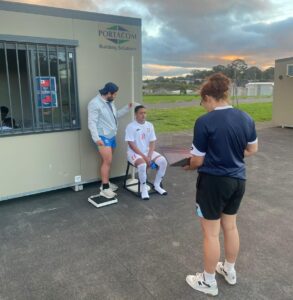
We monitored 147 male outfield players (averaging 14.35 years of age) from nine different Oceania countries during a U15 international tournament. Prior to the tournament, we collected anthropometric data to classify each player’s biological maturity status relative to their Peak Height Velocity (PHV)—grouping them into Pre-PHV, Circa-PHV, and Post-PHV categories.
During the tournament’s 17 matches, the F-IMUs quantified gait metrics such as contact time, flight time, and stride length. This research is important because the rapid physical growth surrounding PHV can temporarily disrupt a player’s motor coordination, a concept often referred to as ‘adolescent awkwardness’. Understanding how these growth phases interact with match fatigue allows us to better support youth development and advance our knowledge of injury prevention.
Take-Homes and Applications
Our findings revealed some surprising insights regarding tournament play. We found no significant between-game differences in gait symmetry or cadence across the tournament, which suggests that the recovery periods between matches were adequate and players did not suffer from cumulative locomotor disruption.
However, we observed meaningful within-game increases in contact duration asymmetry, which emerged as early as the second phase of match play across all maturity groups. Interestingly, Post-PHV players demonstrated greater odds of exceeding a 5% asymmetry threshold compared to their Pre-PHV counterparts.
For sports and exercise science practitioners, the key application here is that acute, within-match fatigue poses a more immediate neuromuscular challenge than chronic tournament fixture congestion. Practitioners should consider integrating wearable technologies to monitor gait symmetry during matches to identify early fatigue responses. Furthermore, because Post-PHV players are more susceptible to these asymmetrical changes, it is highly recommended to implement targeted neuromuscular and unilateral strength interventions during and after periods of rapid growth to support their coordination and stiffness regulation.
Author Bio
Dr. Steve Barrett is a researcher and sports science practitioner affiliated with Playermaker (VP of Sports Performance, Research & Innovation) and SPARC Sports (Consultant). His applied research focuses on wearable technology, load management to optimize performance and reduce injury risk, and talent identification in elite youth soccer.
Linked: https://www.linkedin.com/in/steve-barrett-phd-spsci
Researchgate: https://www.researchgate.net/profile/Steve-Barrett
Dr. Michael King is an academic and applied sport scientist. He works at the University of Glasgow as a Lecturer in Sport Science, as well as working as a consultant to national associations and football clubs. His work focuses mainly on the influence of biological maturation on performance in adolescent football, and how this links to talent identification.
ResearchGate: https://www.researchgate.net/profile/Michael-King-33?ev=hdr_xprf