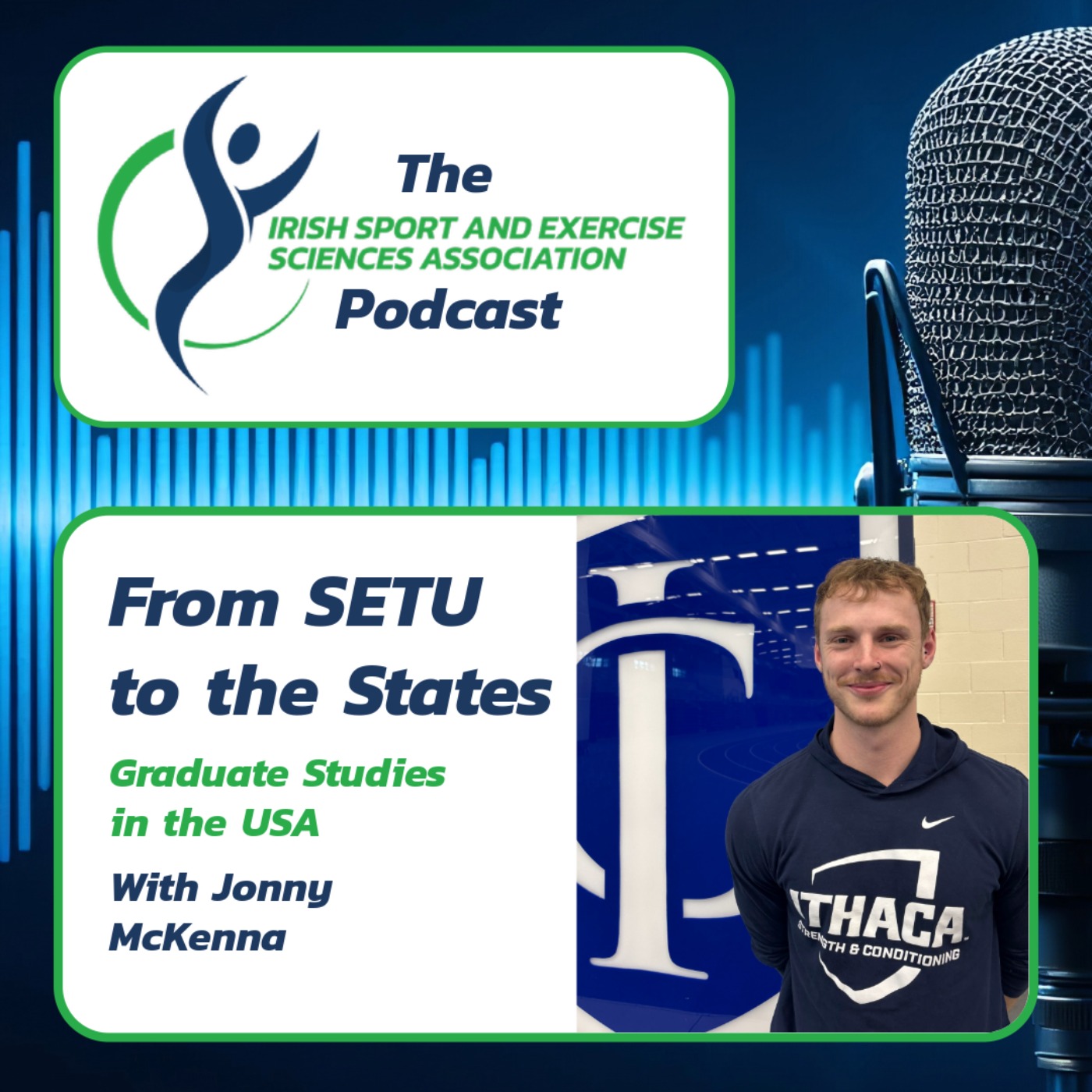
In this episode, Bruce sits down with Jonny McKenna, a recent South East Technological University (SETU) graduate who crossed the Atlantic to complete his MSc in Mental Performance at Ithaca College, New York. Jonny & Bruce go for a deep dive into the realities of pursuing graduate studies and building a sport science career in the USA.
Serving as a natural follow-up to our previous discussions on US graduate studies (season 02 episode 02), Jonny shares the proactive steps he took to secure his dual roles as a Teaching Assistant and Strength & Conditioning Coach which are funding his Masters. He proves that putting yourself out there, leveraging your network, and simply “asking the question” can unlock incredible career opportunities.
So, whether you are an undergraduate mapping out your future, a recent graduate looking for international opportunities, or a practitioner interested in the intersection of S&C and sport psychology, this episode is packed with highly relevant, actionable advice.
Hosted on Acast. See acast.com/privacy for more information.
Irish Sport and Exercise Science Association Podcast
Season 03, Episode 10: “From SETU to the States”
Host: Bruce Wardrop Guest: Johnny McKenna
Bruce Wardrop: Hello and welcome to the latest episode of the Irish Sport and Exercise Science Association podcast. I’m your host, Bruce Wardrop, and you will be glad to know that I have fully recovered from the mega cold that plagued me during our last recording. Before we dive into today’s episode, I would like to thank everyone who was in touch with us about content submission for the upcoming conference. It’s fantastic that there is so much engagement and enthusiasm from our community, and the twenty twenty-six conference really is shaping up to be the highlight of our professional year between now and then. We, of course, have more for you to enjoy—not only this podcast episode, but also the next webinar of the semester on Thursday, twenty-sixth of March. Phil Kearney and Sam German will bring us up to speed on the discipline of skill acquisition. They’ll also present a model to guide applied practice and explore the process for gaining ISESA accreditation as a sports scientist specializing in skill acquisition. I know I have a lot of students who are increasingly interested in this area, and I’m sure this webinar will pique their interest even further. Full details and registration links are available on our website. Okay, back to today.
If you are a current undergraduate or recent graduate trying to figure out your next steps and you perhaps have an eye on something a little further afield, then this upcoming episode is specifically for you. A little while back in season two, episode two, we explored the landscape of postgraduate studies in the USA with Kieran Fairman, Grace Mackenzie and Conor Cantwell. That episode opened a lot of eyes to the fact that fully funded Masters and PhD programs, supported by graduate assistant and teaching assistant roles, are widely available across the United States of America. The core takeaway from that discussion, which was also echoed by Niamh O’Brien in a separate episode when discussing the power of networking, was that these opportunities will not simply fall into your lap. You have to be proactive, do a little bit of detective work, and put yourself out there. Today, we are looking at the practical reality of what happens when you follow that advice.
I am joined by Johnny McKenna, a recent graduate from SETU Waterford, who is currently completing his MSc in Mental Performance at Ithaca College in New York. Johnny is living the dual-role reality in the US collegiate system, balancing his academic studies with active roles as a teaching assistant and as a strength and conditioning coach. In this episode, Johnny unpacks the exact steps he took to identify and secure this opportunity, providing a clear blueprint for anyone who is looking to cross the Atlantic. So whether you are weighing up your post-graduate options, looking for inspiration, or if you just want to hear about another Irish sports and exercise science graduate who is doing well for themselves, then this episode is for you. Here’s my conversation with Johnny McKenna. Johnny, how you doing? You are very welcome to the podcast.
Johnny McKenna: Hi. Thank you. Good to be here.
Bruce Wardrop: Tell me, it is—well, it’s Friday evening, so that makes it Friday lunchtime over there. Is that right?
Johnny McKenna: Yeah, one thirty. Yeah, one thirty. We say half one.
Bruce Wardrop: I’m not allowed to say half one anymore. Okay, one thirty, one thirty. What has your day looked like so far? Tell me about it so far.
Johnny McKenna: I woke up reasonably early to get some corrections done for a TA role that I have. I had a session at ten thirty where I was setting up with Doctor Diggins, the Irish guy, my Irish compatriot over here, who I am a teacher’s assistant for. He’s a lecturer here in sport and exercise science and he has a class for Olympic lifting and just general lifting across the board. It’s a one-module course and I TA for it. And it started at ten thirty and I went all the way till one and then I walked over from there, which is the other side of campus, and walked over to where I normally reside, which is the A and E, which is where I am right now. This is our office. There is a potential that one of our five strength and conditioning coaches may walk in here at some point—I doubt it—and then my tennis boys are currently playing directly outside that door. The guys I coach, they’re playing against—I think it’s Brockhampton or one of those. It’s a random college that they have. It’s not in conference, so I don’t actually know the name of them. And then I’ll be at that for the afternoon and then have more observation stuff in the evening, but we can talk about all that stuff at some point.
Bruce Wardrop: Yeah. So that is—is that fairly typical, a busy day like that for you?
Johnny McKenna: Yeah, it really is. It’s pretty much every day. This is definitely an especially busy one from the length of like non-stop from ten thirty to eight p.m. It is pretty—I won’t say unheard of because it does happen, but it definitely is a busier day. But yeah, you can be sure that I’m pretty busy most days.
Bruce Wardrop: Okay, well, let’s put a little bit more shape on what it is you’re actually doing. So you headed over there to pursue a masters? Tell me about the masters that you’re doing.
Johnny McKenna: Yeah. So I’m doing a master’s in mental performance. Basically what that is, is we’re under the exercise science graduate program. There’s two different pathways. There is the human performance and then there’s the mental performance. Human performance is much more biomechanics, physiology, all of that kind of anatomy—that side of things covers an awful lot of different scope in that area. And then the mental performance is technically sports psychology, but they just renamed it because it actually applies to more kind of areas other than just sports. But technically what we are training for in that graduate program is we come away with a master’s in exercise science with this specific focus on mental performance. But we also train for something called the CNPC, which is a certified mental performance consultant.
Bruce Wardrop: Okay. That’s basically a sports psychologist or sports therapist for athletes that can work directly with athletes to help them in a performance aspect. Very good. And tell me, how did you find out about this master’s program? Were you actively looking to go over to the States? Were you just actively looking for a master’s in general? How did that come about?
Johnny McKenna: So I was actively looking for something in the area that I wanted to do that was of a higher level than what I had been doing at this current time. I really enjoyed what I was doing. I was a strength and conditioning coach in Waterford and also working in the arena at the time. I just wanted to push myself that a little bit further. I wasn’t really sure where to go or what to do. And Griffin, who is Maria Griffin from back in SETU, her son, he actually had the connection with David Diggins, who is now my lecturer that I TA for. He basically said to me, he was like, “Hey, look, there’s this college in upstate New York. I’m probably not going to go because I’m going to be going down to Alabama. You should look into it. There’s a great opportunity, some really cool things that you could be doing”. He basically said he thought it would really suit you. So I looked into it and went through all the websites. I had four or five zoom calls with both Doctor Diggins and Doctor Orsino, who is also our course head, and talked through all the different things. Had a look at what they were offering, and turns out the deal really was almost too good to be true, to be honest, in how it worked.
Bruce Wardrop: Well, so that is—this is like one of the reasons I wanted to speak to you because it’s a nice follow-on from the episode that we did last season with Kieran Fairman, who was telling us about this system of the options and the availability of postgraduate study in the US for Irish students and the opportunity to work as a teaching assistant or a graduate assistant position while you’re there. So that’s one of these things you landed. So tell us how it works for you.
Johnny McKenna: Yeah, absolutely. So I applied under a graduate assistant checkbox, for lack of a better word, when you’re applying for your master’s that you can apply to, to say, “Hey, I’ve got experience in an area”. They give you the list of areas. If you have experience in those areas, you can apply for it. Send your CV, and after they interview you, they go through a whole process to see how much experience you actually have. Essentially, when you get accepted for your master’s—you get accepted for your master’s first—then you’ll continue to go through interview processes to see where you’ll get put, if you’re going to get a graduate assistantship or if you’re going to get one at all.
And so I applied and there were five options. It’s like wellness, kind of rehab side of things, there was just general coaching for teams, and there was strength and conditioning. Then there was another area that is now slipping my mind, but there are five different areas and you have to check whichever ones you had experience in. And I actually just checked each one. I literally read the titles and I was like, “Hey, I technically do have experience in all of these different areas, so I’ll apply for each one”. With the hope that the strength and conditioning one would be the one that they’d give me. But if they didn’t, I wanted them to make sure that they knew that I had experience in the other areas, so if I didn’t get this S&C one that I’d get a GA somewhere. I applied for all five, got the S&C, had the interviews for that, and I got an email within a week of being here saying, “Hey, your hours are actually split between S&C and TA”. So I’m actually a split GA, and I don’t think there’s a single other split GA in the entirety of first year for graduate across the whole program. I don’t think there’s another one person who does that.
Bruce Wardrop: Experience-wise, that is probably going to pay off in the long run for you, though, is it?
Johnny McKenna: One million percent. The thing is, in regards to experience, it’s been second to none. I can’t think of a better way to do it in general, because now I have an even broader scope of things that I can now go towards. It’s been amazing. It’s been hard. I’m not going to sugarcoat it and say that it’s been the easiest thing in the world because it hasn’t. It’s been busy and it’s been tough. But now where it’s come to, and even now I’m in my second semester at this point, it’s really kind of—I’m landing on my feet, so to say, because I’m really figuring out where I’m at and the puzzle pieces are finally starting to fit together. Relationships are formed and there’s just better communication and stuff like that. It’s just become a lot better. So now everything’s really almost flow state, we’ll say.
Bruce Wardrop: I’d love to hear it. That’s fantastic. One of the other guests I spoke to in the previous episode was Grace Mackenzie. And she was doing something similar to you, working as a teaching assistant while she was on a sports scholarship and doing her post-grad at the same time. And I remember her saying that, yeah, the workload is heavy. You’re trying to balance a lot of things. You’ve got a lot of plates spinning in the air between the teaching that you’re doing. I think you mentioned to me before we started recording, you’ve got some grading to do and feedback to get for students before you had to do something else. So you know, how is that working out? What’s the learning curve like with all that?
Johnny McKenna: Wow. So I got very lucky in a way that I’m the age that I am because I do have quite a bit of experience in a lot of different areas, which does work well for what I am a TA for.
Bruce Wardrop: Tell us, what age are you, Johnny?
Johnny McKenna: I’m twenty-eight or—sorry, twenty-seven. Twenty-eight. I’m twenty-seven.
Bruce Wardrop: Twenty-seven, yeah. I do that as well; I add a year onto myself by mistake all the time. So you’re a recent graduate. You graduated a year and a half, two years ago now.
Johnny McKenna: Yeah, yeah.
Bruce Wardrop: So you were doing the maths—you must have been about twenty, twenty-one when you were starting that. Is that right?
Johnny McKenna: Yes. Maybe a bit older. When I was starting, I was twenty-two. Yeah, twenty-two.
Bruce Wardrop: So you were a little bit older than a typical undergrad in Ireland starting. And what do you think that is—that that little bit of maturity and experience is now standing to you?
Johnny McKenna: Yeah, absolutely. I’ll just be honest and say that I think it’s doable. You can absolutely do it when you’re younger and it would probably form you in all sorts of other ways. And I’m sure that it would give a whole different life path if I was much younger and had done it and then come here; it would have been a whole different ball game and I would have probably looked at it in a whole different way and had a whole different outcome, I suppose. But for the age I am and being here, it’s been something I can almost say I can put myself into more comfortably and know that I’m able to deal with it from experience—and that’s not going to break me, I guess.
Bruce Wardrop: Yeah. Because when you were heading over—and I know we spoke before you took this opportunity—I remember thinking that you would be a good candidate. It’s funny, I didn’t realize that you were that little bit older, but in my head, I did know that you were quite experienced. I would have put you into that quite experienced category when it comes to strength and conditioning heading off to do this role. So I was confident that you’d do well in it.
What has it been like? One of the things I’m always curious to hear about in American colleges—I know there’s huge competition between the colleges over there, there’s a lot of investment, they’ve got their philanthropists investing money in their sporting programs —was Ithaca as—are the facilities and buildings and all the sporting stuff what you thought it was going to be?
Johnny McKenna: Yeah. So I’d love to be able to just pick up my laptop and actually just walk you around out there because the building I’m in currently is the main indoor track where a lot of our gym weight room is just down the hall. It’s literally right beside us. And then there’s a bunch of tennis courts, as you can imagine from the boys playing tennis outside, and then track all the way around. And then yeah, it’s quite something. I can talk more about the D3 side of things. How grading works in college—D1, D2, and D3—it was something that I knew about coming over here, but I didn’t fully know until I got here and started asking the questions. My entire program cohort, they’re all ex-athletes basically, so every single one of them could give me a very strong insight into exactly how it works and what the different tiers mean.
D3, for a long story short, essentially is non-scholarship. They cannot give any scholarship to athletes from a sporting perspective. They can give academic scholarships and different stipends and stuff like that, but they can’t give any sporting scholarships. D2 is its own kind of beast—I’d say it’s almost like this stepping stone between D3 and D1 quite literally, where they can offer some scholarships. And then D1 is the full scholarship side of things, but it tends to obviously be the most competitive. And so the highest standard of athlete would be the D1 side of things. They would be your Olympians and anyone who is at that peak of sport in America.
But in saying that, looking at that, a lot of people would probably think, “Hey, D3 is probably not all that great,” but it’s actually surprisingly high standard compared to what you’d think. D3 is highly competitive, it is really cared about, and it is loved across the board. Coaches care—I would say you’d be shocked to know just how much money and time and effort goes into D3 compared to what you would think just based on it being the lowest of the three tiers. For a D3 College, Ithaca is right up there. I think we’re ranked fifty-second in the nation from a sports perspective. That’s across all of our sports; we get tiered into basically how we perform each year at a national level in our conference championships. However well we do, we get tiered against every other college around the nation. We’re fifty-second out of something like two and a half thousand or whatever it is.
Bruce Wardrop: So—okay. Yeah. So I’m picturing it as you talk about it—it’s not quite the peak of the performance pyramid, but it’s still right up there.
Johnny McKenna: You’d be really surprised at just how much time and effort gets—they really invest into these teams and into the level of sport here. It’s quite something, but we really are a bit of an exception. I will say not all colleges are able to afford to have the resources that we have and the coaching that we have. We have five strength and conditioning GAs alone, which is unheard of in D3. There are seven, eight, nine S&C coaches total for all of our teams. I have heard of institutions that have one S&C coach for the entirety of their institution, so it’s a little bit of a luxurious position here. But at the same time, that doesn’t damper any of the work effort; it just means that there’s that little bit more support for you to lean on if you need to, which is nice.
Bruce Wardrop: And tell me, you’ve mentioned the tennis players. What sports have you been put with or what sports are you working with?
Johnny McKenna: So I’m an assistant for American football—that’s my assimilation coming in there real quick. Then I am the lead S&C for swim, male and female, and then tennis men’s.
Bruce Wardrop: Okay, so I know you’ve got an athletics background. What about—I presume you’ve never worked with American football before?
Johnny McKenna: Yes. What about tennis and swimming? No, tennis and swimming I’ve never worked with either. Not at all.
Bruce Wardrop: And how has that been, getting thrown in with sports and athletes that—I know strength and conditioning is strength and conditioning, but there are nuances to every sport. I remember the first time I ever worked with swimmers. They were speaking English, but I still didn’t understand what they were talking about when they were saying things about their training and their times; it took a while to get my head wrapped around that.
Johnny McKenna: Absolutely. The biggest learning curve for me was the meets—going to the meets and understanding what was going on, like the actual races, and having no clue what a fast time was or what I should be cheering for. But from the weight room side of things, the biggest thing is the needs analysis of your athletes. What they need is what you need to provide. I know we said strength and conditioning is strength and conditioning across the board, and people did ask me when I was coming in here, “Hey, you’ve never worked with them before, how are you going to do it?”. And I’m like, “Hey, I understand the basics and the fundamentals, and you then tailor your knowledge based on the sport that you’re working with”. I know how to work the shoulder, therefore I can program for the shoulder.
The nuance really comes into what your athletes need at a time in the season. One of the biggest things for me with swim was understanding that it’s a sport where volume is king at the moment. Because it’s a non-impact sport and they’re in the water and it’s buoyant, they have the tendency to believe that they can do ten times the amount than most other people can—and in theory, they can. If you were to put the amount of volume or distance that a swimmer does on a daily basis into a track program, you’d break your athletes in a second. So having that in the back of your mind and understanding the fatigue ratio for the shoulder is one of the biggest things. Even the hips from kicking—understanding that they’re coming into you pretty beat up and you need to tailor it accordingly. I definitely had an awful lot of moments this year where I was feeling very empathetic for my poor swimmers who I’ve really developed a close bond with. Seeing them in pain or just being tired and working really hard is something you definitely need to account for.
Tennis then is also quite similar in a kind of distance and volume-wise, but obviously you just tone it back for being on the land. They’re doing a lot of tennis, playing a lot of games and an awful lot of match-day scenarios throughout the week. So understanding that they have a little bit less in the weight room and having to program accordingly is definitely the key there. But I’d say the biggest thing for me overall is really just understanding what your athletes need at that time, regardless of sport. I can talk more about KPIs and specificities, but it could get pretty deep pretty quick. So maybe that might be a little webinar to do with my students. No problem.
Bruce Wardrop: I’m curious then, so how do you get opportunities with the masters that you’re doing to bring the psychological side of things into the weight room, into the practical work that you’re doing with those athletes?
Johnny McKenna: So I will preface that there is an awful lot of ethical conduct and ethical codes that go into being a sports psychologist. Without having the title of CNPC, I can’t say that I’m counseling or helping in that way, so I have to be careful in how I describe that. But the fundamental skills and techniques that we learn on a daily basis are ones that I implement all the time. There’s constantly that work with athletes to ensure that they’re seeing what they need to see. A lot of it comes down to encouragement and making sure that they’re in the right headspace and feeling good about what they’re doing. You can also kind of tease out some little things that you are learning and see if they work and see how the athlete responds.
The big thing for me really is that understanding of how the weight room is feeling. Atmosphere is the big thing for me from a mental performance side of things; I’m able to pinpoint and know when athletes are feeling that a little bit more down and what they might need in that moment to be able to pick them back up. If you want to be specific to my techniques, it’s arousal regulation and all that stuff, but I won’t go too sciencey.
Bruce Wardrop: That’s really, really interesting. Outside of the weight room and outside of the classroom, moving from Ireland to the States—what was that like? I know it’s a funny old time to be moving over to the States at the moment, but how was that transition for you?
Johnny McKenna: Yeah, it was—I’ll say my specific situation is probably going to look quite different to what most people will experience, so I won’t say that everyone’s going to experience what I experienced because I don’t want to discourage anyone. I guarantee ninety percent of the time it would be a lot easier than it was for me. I had one of the most unique scenarios happen to me in that I was accepted for my master’s in March of twenty twenty-five, and I didn’t know I was leaving until July, and I flew in August because there was a pause put on visas—all visas across the world. You couldn’t apply or get an interview to get your visa for two and a half to three months. I was basically left in a limbo after doing all my work, having everything together, and paying for everything that I needed to do.
Bruce Wardrop: So you were caught in that pause where you literally—okay.
Johnny McKenna: So I couldn’t book my appointment; it was the last step in the journey and I couldn’t do it. Normally you’d want to get your visa appointment way out of the way. I’ll give the advice: get your visa appointment way out of the way. Do it even earlier than I did, because I was four or five months in advance and I still ended up getting caught by that. Four to five months is probably pretty okay normally, but with that situation specifically, it was rough. So I was left in a pretty severe limbo until a month before when I got my appointment, and then it was all bang, bang, bang real quick.
Bruce Wardrop: So did you just have to sit out that three-month pause or what way did it work?
Johnny McKenna: Yeah, it’s a wait. I basically was just sitting up in the Arena. Anyone who was working with me in the Arena knows that I was sitting in there and everyone was asking me every single day if I got an appointment. I was worried.
Bruce Wardrop: Yeah, I can imagine. I didn’t realize you were caught out by that. Okay, so let’s just park the pause. Prior to the pause, applying for the paperwork and all the stuff that you had to do—how did you find that? Was it cumbersome?
Johnny McKenna: Yeah. The most cumbersome aspect of it is probably finding each individual form and knowing which ones you needed based on your specific scenario. For students, it looks very different on an F1 visa to people who are on working visas or holiday visas, and they’re all kind of lumped together. It’s really not as daunting as you’d think it is. It wasn’t that bad; I got through it pretty quick and pretty easy. The longest thing I had to do was my master’s application—that was definitely the longer of the things. But when it came to the actual forms, I’ll be honest and say that ChatGPT helped me out a lot. AI was extremely helpful for being able to Google and make sure that I had the right things and found the right sites. The information is very much out there; it’s just being savvy enough to find it.
Bruce Wardrop: I’ve just had a flashback there—I remember helping another student and it being so tricky. You had to fill out one set of forms for the academic part, another for the graduate assistant program, and then a completely different set for the student accommodation part. What’s your living situation? Are you renting? Are you on campus?
Johnny McKenna: I had an advisor who was a lecturer in Johns Hopkins who actually is from Waterford, Tom Hennessey. He helped me a ton and pushed me to go in the end; I have to give him a shout out because I wouldn’t be here if it weren’t for him. He lived in America pretty much all his life and he told me to live on campus at first because you’ll make friends quickly with people in your cohort. Then when you make friends, pretty much all of them are probably going to want to live off campus because it’s way cheaper. And so I did literally to a T; I lived on campus for the first semester in Circles. And then for the second semester I moved off campus and I’m now living with two other guys: an ex-American footballer and another GA who is the lacrosse GA here.
Bruce Wardrop: That obviously makes it sound like you’ve settled in over there. It’s not just all work, work, work.
Johnny McKenna: Absolutely. It felt like it was going to be all work at first. But I would encourage anyone who’s doing this to understand that it is so much more than you’re probably used to doing—the workload is nowhere near the same as an undergrad in Ireland. But it’s not the end of the world because you get used to it and find your feet eventually. Once you find your feet, you’re able to make friends. Talk to people—that’s the big thing.
Bruce Wardrop: You’ve hinted at it as well—it’s a very Irish story that you found the masters through someone who then had a contact that happened to be Irish. It proves the point that you put the feelers out, ask for help, and people will be willing to give you that advice.
Johnny McKenna: Honestly, that’s it. Just reach out, say hi, and have those conversations. The worst thing that someone can say is no.
Bruce Wardrop: I always say that to my students. If they say no, you’re no worse off than you were before you asked.
Johnny McKenna: Yeah, I took that with a grain of salt in class, but now I wish I had started even sooner because it really does pay off.
Bruce Wardrop: It sounds like you are in the right place at the right time for you. I was talking to some third-year SETU Waterford students the other day who were having a mini panic attack because they didn’t have their lives planned out yet. I was just saying to chill out; there is plenty of time to sort this all out.
Johnny McKenna: Absolutely. You will find certain things easier if you are older. Right place, right time is always going to be where you’re at.
Bruce Wardrop: Johnny, I really appreciate you taking the time to talk to me. It’s been fascinating. I hope that some students listening might be inspired by what you are doing and look beyond Ireland, because these opportunities are achievable for Irish students. You’re living proof of that.
Johnny McKenna: Absolutely, I appreciate it. Thank you for having me.