
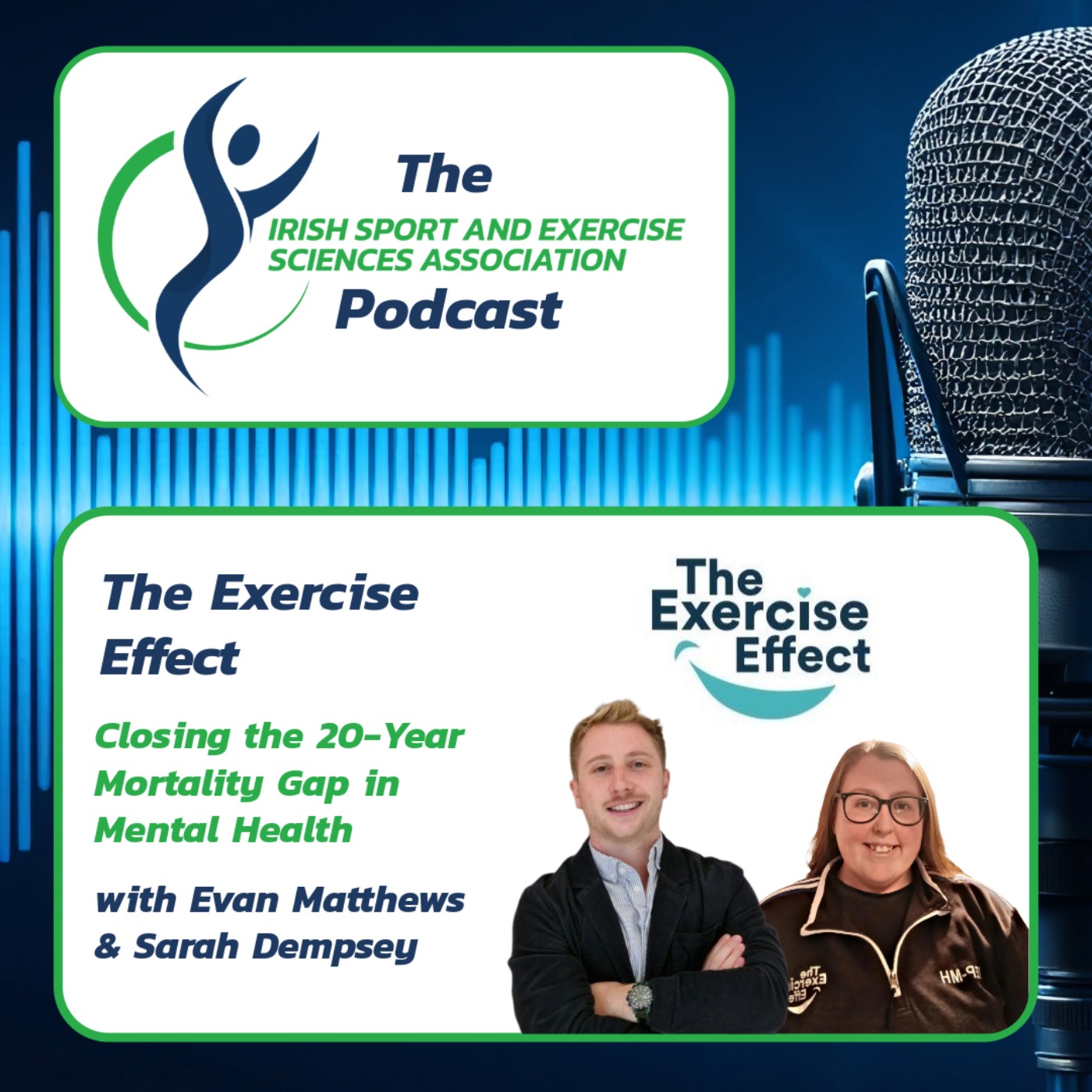
People with severe mental illness face a staggering 15–20 year life expectancy gap compared to the general population. This is a scandal of inequality, largely driven by preventable physical health issues.
In this episode, Bruce sits down with Dr. Evan Matthews, researcher at SETU Waterford and co-author of the recent Lancet Psychiatry Commission report on lifestyle interventions in mental health care. They discuss the evidence behind the “Exercise Effect” pilot—a project integrating physical activity directly into mental health services—and how recent TU Rise funding is helping to drive this impactful research forward.
We are also joined by Sarah Dempsey, an Integrated Exercise Practitioner working on the ground in Wexford. Sarah shares the reality of helping service users take that first, daunting step into a gym, the strategy behind her staff “Lunch Crunch” classes, and the transformative effect the program has on lives.
Including powerful testimonials from service users Dylan, Sheila, and Charlie, this episode is a moving testament to the power of bridging the gap between physical and mental healthcare.
Topics:
- The “Scandal” of the 15–20 year mortality gap.
- Why the “Exercise Effect” integrates practitioners into clinical teams.
- The difference between “Intrinsic” and “Autonomous” motivation.
- Real-world success stories from Wexford.
Hosted on Acast. See acast.com/privacy for more information.
S03E08
The Exercise Effect: Closing the 20-Year Mortality Gap in Mental Health
Bruce: Hello and welcome to the latest episode of the Irish Sport and Exercise Science Association podcast. I’m your host, Bruce Wardrop, and the topic of today’s episode stems from a statistic that, frankly, stops you in your tracks. People with severe mental illness face a life expectancy gap of fifteen to twenty years compared to the general population. It is a stark inequality that is largely driven by preventable physical health issues in those with severe mental illness.
To discuss a program designed to tackle this inequality, I am joined today by two guests, Evan Matthews and Sarah Dempsey. Evan is a colleague of mine in SETU Waterford, whose research interests explore mental health behaviours amongst hard to reach populations such as those with mental health difficulty, substance use disorder and intellectual disability. Very recently, Evan was a part of the International Authorship team that developed a major publication in The Lancet Psychiatry, focusing on implementing lifestyle interventions in mental health care.
Evan’s research capacity has been further bolstered recently by TU Rise funding, which allows him to continue driving impactful projects such as The Exercise Effect, a pilot project that integrates physical activity directly into mental health services provision in Ireland. We don’t just look at the research. We also have Sarah Dempsey, a health and exercise graduate who is now employed as an integrated exercise practitioner working on the ground in Wexford. She shares her insights into the reality of helping service users take that first, daunting step towards becoming more active and the transformative effect it has on their lives.
This is an important conversation about bridging the gap between physical and mental health care, something that is often overlooked. Evan was able to share some really powerful testimonials from people who have been part of the Exercise Effect pilot program. So before I bring you my chat with Evan and Sarah, let’s kick off by hearing from Dylan, one of the service users.
Dylan (Testimonial): My name is Dylan, and I have been living with psychosis for ten years. The one thing I’ve learned about having a mental illness is that it doesn’t care who you are. It’s not ageist, racist, sexist, or bigoted. It can appear in many forms and take many things. And for me, it took away my normal way of life. It filled my head with doubts, paranoia and grinding me down until I was a little knob of self-consciousness. It took my friends, my dreams and my dignity.
Then the one-to-one exercise program came along and it changed everything for me. It did a complete U-turn on my life. When you have a mental illness, it’s possible to sometimes think society has given up on you. They don’t belong in it. But the one-to-one exercise program has taught me to feel valuable again, and it gave me the confidence not only to do things on my own, but other people do.
Before the wonderful exercise program, I spent all day in bed. I was irritable and I was feeling down because I had nothing to do with my life. No purpose, no friends, no future. But the program gives you a purpose and the tools to live your life again. Session by session, you begin to feel better. You get to know other practitioners and have a laugh with them. They offer you not only valuable health insights, but life advice. They become close confidants. You build a relationship with them. Then you start to notice your confidence grow. Your laugh and smile returns. You feel better in yourself. You have structure to your day, and you eat healthier because you realize the importance of a healthy mind going hand in hand with a healthy body.
Today I have more friends than I’ve ever had. I visit the gym regularly. I’ve joined the badminton club. I do courses, but most importantly, I feel well again. All because of this program. This program has the power to change lives. It has been instrumental in changing my life, and I have no doubt lives can be saved by it and improved by it. Mine certainly was.
Bruce: Evan and Sarah. How you doing? Good morning. You’re very welcome to the podcast.
Evan: Morning, Bruce.
Sarah: Morning, Bruce.
Bruce: Evan, I might go to you first. And I hope this doesn’t sound terribly patronizing, but in my mind, you know, you’re a relatively new researcher. You know, you finished your PhD about five years ago, but in my mind, it only feels like it’s a couple of months ago. And in those few short years, you’ve achieved quite a lot, culminating with this publication in The Lancet Psychiatry. But you might just give us a little overview of that journey, the research area that you’re interested in and how that’s progressed over the last few years for you.
Evan: Well, thanks, Bruce. That’s very kind to say. Um, well, all the work that I’ve been doing has been part of a team, so I can’t take any sole credit on that one. But yeah, look, it all stems back to my PhD. So when I was doing my PhD, I got an opportunity to go to the University of New South Wales in Sydney, where they have a connection with a lifestyle integrated program in the mental health services over there. And I got to see what was going on, and we brought the learnings back. A guy called Phil Ward and Simon Rosenbaum came to Ireland and helped us to communicate with the mental health services in the southeast. And we ran a seminar and the services attended. And from there, we hatched an idea to try leverage some funding for an integrated exercise role in mental health services in the South East. So it all does actually stem back to my PhD five years ago. But it’s been a bit of a journey from there.
Bruce: So, Evan, that is fascinating about the time in Australia. So after you came home from Australia, that was during your PhD. How did that turn into this after you completed your PhD?
Evan: Yeah. So it was a great opportunity for me. And when I came back from Sydney, I was highly motivated to try and do something and try to affect services. Myself and a colleague who I was working with already in the mental health services, Paula Lowney, with Suzanne Denieffe at the time, we put together a workshop in Waterford and invited mental health services and community partners together to learn about innovations for exercise and mental health services. The team from Sydney came over and helped us with that as well.
Based out of that event, we formed a group and that included the local sports partnership in Wexford, the mental health services in Wexford and ourselves. And we got some funding through Sláintecare. And that was the origin of the first integrated exercise practitioner in Wexford. That was funded through the Sláintecare programme. And then of course, time passed and the project grew and we realised the success of it through our evaluations. In 2023, the mental health services in Wexford and Waterford got behind it and recognised the value. And I think that was a really powerful moment where they said, “You know, this really works. We’re going to back this project and we’re going to support practitioners in Wexford Mental Health Services.”
And that’s where we are today. And my own support as well from the university under the TU Rise program, which is a government of Ireland and European Union initiative in SETU as well. They back me now as well for the last few months to just focus my time and energy on looking at this initiative. So it’s been really a great synergy of organisations kind of coming behind this idea and exploring where it’s going to go.
Bruce: Well, tell us a little bit about that. So what were they doing over in Australia that we weren’t doing over here?
Evan: Yeah. So they realised over there that people in the mental health services were experiencing an awful lot of physical health issues. And of course the mental health services were geared and orientated to address people’s mental health needs, and they felt like they were missing something with addressing their physical health needs. So that inspired their investigations to look at what could they do? And of course, lifestyle interventions, namely in this case physical activity and also dietary interventions and smoking cessation interventions, are a good first place to look when you’re trying to address physical health needs, as we know.
And then, of course, pretty quickly when you start to integrate those into mental health services, it’s a more intensive wraparound support and it can engage people and keep them involved in those interventions. And they realized, of course, then through research that there was a powerful mental health therapeutic to it as well as a physical health benefit. So obviously research has been happening in many different sites, not just in UNSW Sydney.
So, I suppose the learning there, and in subsequent papers that I’ve had the good fortune to be involved with, is that it’s an integrated approach to lifestyle interventions. That’s what’s really, really key here. So because of the—and Sarah will talk more to this, I’m sure, about her own experience—but because of people’s mental health needs, there’s additional barriers there for getting involved in something like exercise. And that integrated approach really helps to bring a person along and support them to do that. And then as I mentioned, then the mental health benefits then fall into place pretty nicely when you have that well-structured service.
Bruce: So would I be correct in saying that this type of approach was initially set up to approach health issues that people with mental health issues were suffering from? It wasn’t set up to address the mental health side of things initially. Correct?
Evan: Yeah. And actually, you know, I’m probably being light touch in how I describe that problem. So if you look at the evidence around this, the physical health issues that people with severe mental illness experience has been described as a scandal. Because it’s a complete disparity compared to the population that doesn’t have severe mental health problems; they die fifteen to twenty years younger. They experience chronic physical health issues that are entirely preventable when you have good interventions in place. So, in a lot of ways it’s a huge inequality scandal. And when you do robust lifestyle interventions—and also medication has to be considered too, I’m not trying to downplay that either—but when you have the right interventions in place, those physical health issues, they don’t need to happen. They’re completely preventable. And that’s why these are so important.
Bruce: Like it’s not an area that I’m terribly familiar with. And I’m sure that’ll be the same for some of our listeners. So when you say someone with severe mental health issues, what does that encompass or what does that entail?
Evan: It’s a really good question. And, you know, it’s hard to kind of put it into a box. You know, there are diagnostic categories that are often attributed for medical reasons and to classify things as a disease or an illness. People would be familiar with terms like schizophrenia, bipolar disorder. And those disorders typically occur on a spectrum, but they rarely kind of fall into like a discrete nice description of “this is schizophrenia” or “this is bipolar disorder.” The symptoms can be wide and varying and overlapping.
And I know Sarah will probably talk about our experiences of trying to help people overcome barriers that they experience for exercise. But you might be talking about someone who has issues with very low mood, someone who might have issues with experiences of psychosis where they might have perceptual challenges to overcome, like they might hear things or have beliefs as well. So it’s hugely complex and it’s very often overlapping. But that’s what we’re talking about when we’re talking about severe mental illness. And when it’s severe, of course, it’s at a level that it affects someone quite profoundly. And they might need a bit of additional support to overcome that.
But just one point on that as well, is to move away from the medical side of looking at it too. There’s a recovery perspective on these things too. That’s really important to consider, because you can have a diagnosis of a severe mental illness, but then you can be in complete recovery and I have many friends and family that have got a severe mental illness, and they have jobs and relationships and they’re perfectly healthy, functioning individuals as well. So recovery works on a spectrum, you know?
Bruce: Yeah. I don’t mean to make light of it, but as soon as I asked the question, I was thinking, okay, that’s an awful question. There’s no straight answer to that. But maybe, and I’m not trying to oversimplify it, but maybe would we say, like there’s a broad spectrum of things that people could be suffering from, and perhaps it’s how severely that impacts their ability to go about their day to day life? Is that oversimplifying it a little bit?
Evan: Yeah, yeah. I mean, like any kind of health condition, if it’s at a level where you’re experiencing it in a severe stage, you’ll need support from medical and health professionals. So I suppose the people that are in the mental health services, specialist mental health services, they require that little bit of support at that time for their mental health needs. And I suppose that’s what implicates maybe the level of severity. But, as I said, with the right input someone can achieve some recovery and they can then step down the level of mental health need and input that they require.
Bruce: Yeah. Sarah I’ll bring you in there. So can you tell us about your role. So you are one of the integrated exercise practitioners for mental health that was brought in under the program that Evan and his team brought to Ireland. So tell us what it is you do.
Sarah: Yeah. So, like Evan said. Anyway, Bruce. So as an integrated exercise practitioner for mental health, we’re there to support the individual with maintaining and achieving physical activity goals. But not only that, but to connect them with the community and different local groups where possible. So post-intervention would be kind of trying to aim to refer the guys to maybe a certain area that they enjoyed while they were exercising with me.
But other than that as well, Bruce, we also work like Evan said as well, most importantly, as an integrated element. Not only with just the individuals in the mental health services, but with the teams as well in the centers, which is just as important, I think, as working with the individuals themselves. And so having the whole integrated approach there, I think is like the most important part of integrated exercise practitioner.
And the main kind of day-to-day then I suppose would mainly consist of one-to-one exercise appointments. So the program runs a minimum of six weeks to a maximum of eight weeks. And then usually the first appointment is their pre-assessment. So in that then, I’d gather information on kind of health and lifestyle questions. And I’d also do a few goals, set goals with them. They also complete the consent form as well on that day. And then depending on their PAR-Q, so sometimes we have to get doctor clearance.
However, from there then we organise weekly appointments. So the weekly appointments are usually one day a week for an hour, and their last appointment then is usually their post-assessment. So again, come back in and gathering information on the health and lifestyle questions again. But also it has a feedback element then where the guys give me feedback on things they found beneficial and challenges. Overall feedback then as well, like would they do it again or do something different next time.
And then as an IEP, I provide the exercise plan for them to bring home with them. There’s also an example of an exercise schedule for them as well and an exercise tracking chart. So we try to encourage them then to keep going with what they’ve established over the weeks with us. But like going back to Evan as well, it’s part of their treatment plan. As important as it is with their medication, the exercise is also another element to their treatment plan and their recovery. That is beneficial and is proven to help as well. Hand in hand kind of with medication, having a balance between all fronts.
Bruce: So you say there, I think you said one hour a week for about six to eight weeks, so that feels like it’s a short intervention. How do you find holding on to people after that? Is there a bit of a sweet spot there where I guess there might be some initial resistance or reluctance or apprehension from the people that you’re working with? And what are they like from that first one hour session towards the sixth or the eight? And how do they want to continue after that?
Sarah: Yeah. So I suppose everyone responds differently, Bruce. When they come in, everyone’s at a different stage. When they’re starting with me, usually starting is the hardest part. I suppose once you have that initial first appointment, put the face to the name and they get an idea of what it actually is. And, you know, I suppose when I ring and offer the exercise program, people kind of think, “Oh, God, exercise,” and kind of think really heavy exercise. But once they come in and I explain a little bit more, that will be gradual and built up, a progression over the weeks as well, they don’t seem to mind as much.
And I have had some that are anti-exercise I suppose, but however, by the last week, they’re leaving and they’re getting referred back to me, you know, that they want to come and do it again.
Bruce: And what does someone who’s anti-exercise, what does that present like to you? What happens?
Sarah: Um, well I suppose they come in and they just have no interest in exercise. They’ve never had an interest in exercise. Don’t see the point in it. Or have never exercised. So you’re kind of thinking, “Oh you know what, what am I going to do here?” type of thing. And it wouldn’t be too often in fairness, most that come in are really willing to get going and want to give it a go.
But definitely when they come in and then kind of halfway through the weeks, then you can see they’re starting to realize it’s actually enjoyable, or they just find an exercise that is enjoyable rather than me telling them to do this or that. We try to establish something that they do actually enjoy. And if they enjoy it, more than likely, then they’ll keep exercising then as well. So it was nice to turn around at the end of the few weeks and to hear that they’ll come back with another referral as well.
So definitely so many different people coming in. If people then that come in and they’re ready to exercise, they do really well and get into a really great exercise routine and structure over the weeks. And they continue it on. Or you could bump into them and check in with them and they’re still doing what they’re doing. Or they could have joined a group in the community or a gym or, you know, they do, like Evan said, progress and step up another little bit from needing the extra support.
Bruce: Yeah. There’s a couple of testimonials that I will weave into the episode from people who’ve used the services. And there’s one that struck me who said that she initially struggled with leaving the house, and by the end of the testimonial, she was saying after the exercise program, she’s now attending three different dance classes and joining in group exercise classes off her own back. Like, obviously you’re not going to all those classes with her. That’s something she’s doing herself.
And I know if I dig my brain back to the very early days of my undergrad, I remember talking about intrinsic motivation and doing things because you loved doing it and you wanted to do it. But, you know, for someone who’s struggling with mental health issues, doing exercise because they love it straight away, that might be something that’s not achievable or not on their radar, as Sarah was saying there. So is there a different approach? What do you want to get with these people? Is it not that they are doing it because they love it initially, but they’re doing it because they want to do it at the end? How is there a difference there between the two?
Evan: Yeah, I mean, look, that that’s an amazing story. Like to hear of someone who is now autonomously pursuing physical activity purely for their own enjoyment, and it’s not even like, “Oh, this is my medicine” or “this is necessary to keep me well,” it’s just intrinsically motivated. They just simply enjoy doing it. And it’s become part of their routine, part of their lifestyle. That’s so powerful. And, you know, that doesn’t always happen obviously. But that’s obviously where we strive to get someone to because that’s when it just becomes routine and the benefits just happen for them.
So yeah, if you think about someone who’s got those extra barriers to overcome… physical activity is hard for everyone. You know, I myself, looking out here and the sky is pretty dark, the idea of putting on my trainers, I’d have to take a second to do it. So it’s hard for everyone, but if you’ve got those additional barriers, a person needs that extra bit of support. So that embedded element of someone like Sarah in a mental health service who’s connected to the wider mental health team, that’s really what makes this work so well.
Because obviously we want people to be doing physical activity and exercise in their community outside of a mental health service. But you do have to in a lot of instances, for some individuals, just bridge that gap. The expectation that someone might just pop into a gym in their local community… that can be a really daunting experience. So you do need someone to bridge the gap and introduce exercise to them. And as early as possible as well in this context.
Bruce: Yeah, I think one of the other testimonials described it as just having… they didn’t necessarily want to do it, but because they had an appointment with you, Sarah, they went to the appointments and that was it. So, they weren’t going to just rock up to the gym one day and go, “Hey, this might help me, I might enjoy this,” but something connected them to you. There was an appointment. There was a contract made that they were both going to turn up at this one time. And that was the first step for them. So what’s that like for you, Sarah, when you go along maybe with someone who might be a little bit reluctant or just on that first day. How do you empower that person to take ownership of their exercise program?
Sarah: Yeah. Well firstly Bruce, definitely that’s the biggest step. And I do emphasize that with any individual that comes into me, and that is a big thing with a lot of the individuals is having the accountability for the exercise appointment. So like you said Bruce, like a contract. They know they’ve come in for their appointment. Like any other appointment I suppose as well. And it is treated just as important in some individuals’ eyes as a doctor’s appointment or a nurse or any other professional’s appointment.
But definitely when they come in… first thing they say, “Oh geez, I didn’t really want to see you today.” And you’re kind of like, “Oh God.” And I say, “Well, thanks for coming anyway.” And I emphasize like, “You came. You could have easily text me or rang me to say, no, I’m not exercising today. You could have made an excuse, but you didn’t. You got here.”
So look, we’ll see what we can get going. Usually in the first few minutes of that session with a person that doesn’t want to see me, they’re a little bit sluggish at the start. And then once they get into it and they get going, you’ll see the mood lift, you’ll see the laugh and the smiles and all come. And then by the end of the session, like next thirty minutes, forty-five minutes has gone by, an hour has gone by and they don’t even realize it. And they’re delighted then they came in. At the end of the day, “I’m delighted I have it done now for today” or “I’m delighted I didn’t cancel.”
But accountability is a big thing with the appointments. A lot of people would say if they didn’t have the appointment, they wouldn’t do it. And even those that don’t want to do it on the day with me, they still come in and they do achieve some form of activity. It might not be as fantastic or as heavy going as their last appointment, but they have moved. Every move counts. So whether it’s light or moderate intensity or high intensity, at the end of the day, they came in, made their appointments, got their exercise done and feeling better usually when they’re going out the door.
Bruce: And just this might seem very basic, but just set the scene. So is it in a gym setting? Is it an outdoor setting? I think I heard one of the testimonials say that you go for a walk with them. Or does that change with every individual?
Sarah: Yeah. So every individual is different, Bruce. Some of the individuals come into the center to me. In some centers I’m lucky to have like a group room I suppose. And I can set up the equipment there or just carry out the general exercise plan with them there. Others then meet me in local gyms and usually gyms that I’ve established kind of a bit of a connection with. So the guys will do kind of more affordable deals for individuals I’m working with as well as they understand who I am and what I do, and they allow me to go in and complete a session with them in the gym then as well.
And others then, like you said, Bruce, I would meet people for walks in local parks or walking tracks. Yeah, or even just doing outdoor kind of exercise as well. Again, in local parks, using benches, using outdoor gym equipment and stuff in parks if possible. So kind of trying to make use of what is available at low cost or zero cost if possible. And somewhere usually that is close to them as well, I find works well because they’re more than likely to go out the door and down to the walking track if it’s five minutes rather than twenty minutes. They’re more likely to keep going or act on the thought of “I’m going to get my walk done.” So it all depends on the person really, and the area I’m in on what’s available.
Bruce: I’m just thinking, I know, Sarah, that you’re a graduate of health and exercise science. And that as an undergrad you would have done exercise prescription modules. But it sounds now that you really have to lean into those skills and you really have to lean into being adaptable and thinking on the go. While you’re working with this wide variety of clients in a wide variety of settings who might have varying degrees of motivation and enthusiasm for what you’re doing. So you really probably have to think on the fly when you’re at it. And then I’m also in parallel thinking that there might be some undergrads who are listening to this at the moment. And hopefully if Evan’s research in this program goes on, there’s going to be opportunities for future graduates in this area. So what would you say to any current students who are maybe just learning these skills or putting these skills into practice?
Sarah: I’d say definitely try and get as much exposure and experience in using the skills as possible. I would have used a good few of the skills in prior placements, but definitely coming into this role… Adaptability is the word. Because you have to adapt, like you said, at any moment. As well as touching on so many other areas, having done the Exercise is Medicine and all the different modules, you’d be surprised. You might think now, “Oh, why am I learning this? I’ll never use that.” But definitely when you go into certain areas, you’d be surprised what comes back to you then as well.
So definitely have everything in your tool belt. It’s handy to have everything rather than trying to find or develop the skills. Be creative thinking of using different skills. Thinking outside the box is beneficial in any aspect.
Bruce: Yeah. I think for undergrads up and down the country when they’re learning these skills, you’re learning in a class full of people who are very similar to you, who are also there with an interest in the area. But then to realize that the clients that you might end up working with are not that group of people. They’re going to be wide and varied, lots of differences in the clients that you’re going to come across in the real world.
Sarah: Yeah, definitely. So kind of prepare for the unexpected. You really don’t know what’s on any day that comes in. Someone could come in today and they’re really ready to go. And they could come in next week and they have no motivation. But you just adapt and do what you can with them and again reiterate encouragement and praise. But definitely prepare for everything.
Bruce: Having those soft skills, listening to you, it sounds like your ability to communicate effectively with the people. And be patient with them, hear them, listen to what’s being said. And then adapt appropriately. Not just adapt the exercise program, but just to adapt your communication style to the individual as well on the go is important.
Sarah: Yeah, one hundred percent. Communication is probably a vital skill. Everyone comes in to the first appointment or even just that initial phone call… your communication is completely different from having to read someone’s voice, read their body language when they’re coming in. So many different elements. And then to correct your communication with them then as well, so that that will work for them. And you have to have the professionalism then as well. On the other side, you have to have the adapting the exercise, the area, adapting your communication.
And it is on a day-to-day basis on what you use. It’s not like I don’t go into everyone in the same manner. It’s all different depending on who’s coming in. And like I said, the professionalism is important, but it’s also important to be normal, if that makes sense as well with people. You do get that, you’re a little bit more relatable. And when you’re relatable with them, that helps build rapport.
Evan: Sorry, Bruce. Just you mentioned opportunities and graduates, and it strikes me that we should really talk about this because obviously, what the project that’s happening in Wexford Mental Health Services, where Sarah is an IEP, that’s a pilot initiative. It was initiated initially in 2019 under Sláintecare. But now that project is centrally funded by the mental health services. So it’s funded and that money then goes to Mental Health Ireland who are the partner. And they employ the IEPs, or the exercise professionals.
So in the next little while, we’re going to have some recruitment going on to recruit an exercise practitioner in Wexford. We have a sister program in Dublin under a very similar model that’s spun off from the work that’s happening in Wexford. I’m pretty sure they’re recruiting for exercise professionals at the moment up there as well. And then we have some really exciting things happening as well where combined the two projects, our sister project in Dublin and ourselves, are developing a role for a central coordinator within Mental Health Ireland as well. So the structures and the opportunities through this pilot initiative are really, really growing. So I suppose watch this space as well.
Bruce: Yeah. So it sounds like it’s really mushrooming into something big at the moment. It’s a good time for us to be discussing it.
Evan: Absolutely. Yeah, really, really exciting.
Bruce: Well, that almost parallels the question I was going to ask. You know, I was thinking, you’re obviously very lucky to have such a good integrated exercise practitioner as Sarah and the program. And if I was to say to you, like, in ten years time, where would you love to see this? I’m sure the answer would be to have integrated practitioners all over the country in all the mental health services. Accessing as many people as possible. Is that a realistic dream to have for the program? Like, we have a good stream of qualified exercise professionals coming out who could fill those roles. Or realistically in something like the HSE, is there going to have to be a bit of maybe upskilling or retraining existing health workers? What’s the future look like, do you think?
Evan: Yeah, I really feel like we’re building on a wave right now. I really feel like this is a really good opportunity. It will get to a point as well. Obviously, there are innovation examples happening in pockets of the country such as Wexford, such as in Dublin. But I think we’re going to see a lot of growth in the next little while. So it’ll become a situation where they just simply can’t… you know, the other international examples are moving forward with this. And I think we have to keep pace for the sake of equity.
So there are a lot of things happening. The likes of the ISESA, it’s a good foundation base that practitioners can build off. There are other developments in terms of upskilling in chronic disease and chronic illness management for exercise professionals. And I think when those things align properly for the HSE, the pathways to establishing integrated exercise professionals and mental health services will be a lot clearer for the HSE to get behind.
And I think evidence and research is going to be really, really important with this. We have a lot of international studies coming out, experimental studies and reviews demonstrating this is really good bang for buck in terms of investment for mental health services. And we’re trying to build as well the evidence base in the Irish context too. So we’re exploring all opportunities to grow our own evidence base.
But when those things align and they are getting there, I think we’re going to see further scale up of professionals and other services. My phone rings every week from services who want to learn about the model that’s been developed in Wexford and they want to try and see if they can do something themselves. And so the momentum is gradually building on it.
Bruce: So I’m hearing reading between the lines there that you’re not only practitioner roles. There might be some postgraduate roles coming out of this as well.
Evan: Absolutely. Yeah. Look you know pilots have to start somewhere. But once pilots are established, structures have to be built around those things as well. So we’re seeing as we go through the process, as the pilot develops, we’re identifying things that need to be done in terms of wider structures and supports for the practitioners to do their job the way they need to. So yeah, we’re learning as we go on the fly. And that’s the beauty of the pilot as well.
Bruce: Like if I think to the news cycle, fairly frequently we’re hearing the pressures that the HSE are under and specifically pressures that mental health services are under. With all the evidence that you guys are building, how do you go about convincing the people who make the decision, the people who are writing policies and funding these programs… How do you go about convincing them that the exercise prescription is as important as the medical prescription?
Evan: That’s a really good question. And I don’t know if I have all the answers. I actually think that probably Sarah has the answers because it’s actually the voice of the people that have benefited from the service. That’s really going to be what tips this, I think. But our job is to try and make that voice heard or to support that voice being heard.
You know, looking back before we came on here, our data in 2024-25, over one hundred individuals had one-to-one service, and over three hundred individuals had access to group based exercise through that program. The benefit for those individuals… a lot of them will go back to doing what they do, or maybe talk with that other person who is doing autonomous activity. We have to find a way to capture their voice and reflect it back to decision makers and funders. And that’s our task. You can bury some of that stuff in academic publications and it may or may not be heard, but we have to try and find a way to amplify the voice of those one hundred odd people and reflect those stories back. It’s often the last thing you think about with these kind of pilots. But we have to do better in that regard.
Bruce: Okay. Well, Sarah, pressure’s on you now. So Evan’s teed you up there. If you were to think of a success story or something that really stands out to you from your hands on work without breaking any GDPR. Can you tell us the story of one of those interventions?
Sarah: Yeah. Well, a story, I suppose is what I’ll have to go with today. But there’s so many stories. Like Evan said, the numbers we’ve hit are fantastic. But definitely so many success stories, from minor things like getting someone out of the house to major things like attending gym regularly, attending local groups, educational courses.
But definitely like Evan was saying as well, it’s powerful when we get the voice recording testimonials. It’s powerful when you play them and you actually hear the real person speaking about their experience and how it’s impacted them. Even for myself, when I’ve heard some of them back, you don’t realize how much of an impact you’ve actually had until you hear from the person themselves.
But even the element of staff, so like staff have had success stories as well. And they really advocate for the program majority and they see it in individuals coming into them as well. I’ve had nurses report back on certain individuals that they’re doing really well. Their paranoia is less, they’re out more. They’re brighter.
And I suppose that’s the joys of doing not only one-to-one, but the groups as well. So I would do staff groups as well. The “Lunch Crunch,” I called it for the staff classes. And that helps again with the integrating part of IEP. So the guys are coming out and they’re doing exactly more or less what I would be doing with one-to-ones or in other groups. And that helps them with referrals. So referrals come in because they know what the actual program is. They know how I work and the environment of the exercise.
Same thing. They come out and they’re kind of, “Oh God, didn’t really want to do this now.” And then at the end of it, they’re all kind of like a pep in their step going back in for lunch. It was a thirty minute high intensity exercise. And then you would see in the lunchroom, the guys that would be after doing the exercise, the mood is a lot lighter. Compared to those that maybe didn’t do the class that day.
Bruce: Sorry, I’m just really curious. That’s so interesting. So that, you know, you obviously were employed to do the exercise interventions with the people who are using the mental health services, but you’re also doing exercise interventions with the other staff that you’re integrated with. Was that deliberate? How did that come about? Like you’re getting some sneaky health benefits for them, but you’re also introducing them to the program and they’re the ones who are providing the referrals. You know, so they can talk about their experience with it when they’re trying to sell it. It’s very clever.
Sarah: I suppose a bit of both. So I did actually have some of the professionals coming to me and asking, would I do a staff class? And I suppose I put the idea out there as well. I was like, “Oh, I wonder if we’re doing a thirty minute exercise class at lunchtime, you know who would do it?” And definitely had the regular faces. Trying to nail down the day and time was the hardest when everyone is doing so many different tasks.
I thought, well, by doing the exercise class like that, they get an idea of what the IEP is and then referrals come from there. It creates their awareness of you as well. That you’re part of the team. So when someone is in consultations or whatever and exercise is mentioned, when they hear exercise, they think Sarah. So then the whole referral comes from there.
But like they’re getting the benefits themselves as well, which is nice to see. The mood uplifting, feeling better and looser. And they’re kind of going back in for the other half of the day with a fresh mind. Actually, the staff class would, and I initially trialed, I think it was four or six weeks, and then it was so successful. I’d done an eight week block then, and I’m due to start another block with them.
Bruce: Evan, I’m curious there. I know that that’s like a nice little something that came out of nothing really doing that little extra bit. But it’s been very beneficial to the program overall. And I know then from looking at the list of authors on that paper that you published, that you’ve been collaborating with people from all over the world, and that there’s going to be countries that have different experiences, that have bigger challenges and smaller challenges than we face here in Ireland. Is there anything that you’ve brought from looking at their experiences into Ireland to try and help improve what we’re doing?
Evan: Absolutely. Yeah. There’s a lot of different elements within it that kind of make this kind of thing work. Staff buy-in is a huge factor. And you know, Sarah talked about how we’re trying to overcome that in Wexford and give a little something to staff. And then suddenly they realize this is a really good idea.
But in other contexts as well, this is a lesson for us in Ireland. We probably don’t often think about it like this, but we actually have, relative to other countries, a wealthy mental health service. But yet it always feels like we don’t have enough. But you can do quite a lot with a very little sometimes, and that’s a lot of the learning from some of the international research out there.
Once you have staff bought into the idea… and staff are busy, I’m not trying to take away from that… but once they recognize the value of it, then time is given over to this sort of thing and it becomes part of the culture of the service. And culture is something that comes from the top down. Then staff time and energy is given over to recognizing the value of integrated lifestyle interventions. Because particularly in exercise, if you don’t have that as an embedded cultural aspect, then you have very sedentary services. A highly sedentary environment is not going to be conducive to good mental health. So once you have this recognizing time and energy given over to it, it’s part of the therapeutic toolkit.
Bruce: So is that something that other countries have noticed as well, or is that something that we perhaps noticed first and you’re feeding forwards?
Evan: Absolutely. And I mean, what’s happening in Wexford is optimal in terms of an integrated exercise practitioner. And that’s what we want to get across the island of Ireland. That’s obviously the ultimate goal. But you know, there are other contexts that will not have an integrated exercise practitioner. And therefore the interventions fall on the existing professionals that are there. So they need to have some capacity to deliver or to support people around their lifestyle. It mightn’t be to the level of expertise of someone like Sarah, but they need some level of awareness to try and support people around their lifestyle behaviors.
There’s a few other things I think, that make this work as well. Obviously Sarah is working one-to-one and doing groups, but I know she works with other stakeholders. We reached into the community as well as delivering within the service. So you’ve got the likes of Sports Active Wexford who are on our committee that have been involved with this programme. So there’s a connection between what happens between the IEP and the wider community as well. So the local sports partnership, obviously we mentioned Mental Health Ireland as well, who are supporting the initiative. So you’ve got other agencies that operate outside the mental health services, but they operate to support the work of the IEP and the mental health services. And so there’s a lot kind of that wraps around the pilot intervention as well.
Bruce: And of course, that network is all over the country. So I presume for you guys trying to link in with more and more to spread this network is key.
Evan: Yeah. It just means that you’ve got a wider network of opportunities, ideas, groups that can be linked into the programme as well. So when you get a person to a point where they can move on as well, there’s a network plugged into the community.
Bruce: You know, guys, it’s been really interesting. I’m going to go to you, Sarah, for the last question, if you don’t mind. And I just want you to think back. I want you to give me, if possible, what’s been your biggest win since you’ve been in this role?
Sarah: Um, my biggest win, Bruce. There’s so, so many I suppose. Like Evan said, like the collaboration with the community, with the other stakeholders, trying to open as much avenues as we can for an individual. Obviously when they’re working with us on a one-to-one basis, but then obviously to support them post intervention as well.
I think one or two stuck out to me. There was one in particular I worked with, and they would have suffered with psychosis for many years. And again, they’ve done a testimonial as well. And it’s powerful. Basically psychosis broke down everything. Their life, their friends, their family, you know, they couldn’t leave the house. Then the Exercise Effect came along. And that helped him build back up friends, family. They’re actually a key member of the majority of groups at the minute. So I have a sports group as well, walking groups, healthy mind healthy body group. There’s so many different elements they’re involved in now. But definitely to hear how the Exercise Effect brought back their life was amazing.
Another person I worked with, they came in individually as part of mental health service, but sometimes they have other physical issues I suppose as well. And like that by adapting the exercises and sometimes by relating the exercise back to everyday life—simple things like brushing your hair—by doing that exercise with them and helping their physical health, their mood improves. When they can then go and put on their shoes quicker, or if they drop something they can bend down because you’ve done lunges with them. So when you help the physical element the mental health is naturally affected. So I find this like a knock on effect. It helps the physical side and it helps the mental health side and then vice versa.
And that’s one thing that one person highlighted with me as well is that the Exercise Effect brought back life, brought back his family, brought back friends. And he’s now doing courses. And he realized through doing the exercise effect then is that a healthy mind goes hand in hand with a healthy body.
And the other person I was thinking of as well, I think they’ve done it twice or three times with me, the program now. Again, I would have suffered with schizophrenia and would have had a lot of paranoia. Now that person has lost I think two to three stone in the space of a few years and goes out of the house and paranoia is completely, um, almost completely gone, but a lot less than what it was previously. And I also connected her to a COPD, a local COPD group, which has an exercise element to it, and they walk to and from the group as well. And they don’t miss the group now.
But like there’s so many. Adolescents, gym exposure… their parents are more than happy with the exercise program because they’re doing the gym, but they’re also learning how to act safely in the gym. We create the link to the gym for them, bring them and show them where. Some of the parents have reported that they wouldn’t even know where to start. But they’ve all the same benefits: improved sleep, improved mood, self-confidence, self-esteem. Oh, the list goes on.
Bruce: Listening to you there, it’s incredible how impactful the work that you’re doing is. To so many things that you listed out there that, you know, well, I speak personally that maybe I would take for granted and that I’m sure plenty of listeners would take for granted. And we don’t realize how much perhaps could be stolen from a person’s life if they’re suffering from mental health issues and then having associated health issues that go along with this. And it’s just really… but for both of you, it’s really, really important the work that you’re doing. And it’s a little bit emotional listening to you talking about it and how impactful it can be for the participants in the program.
So, look, I think that’s a perfect place to leave us. Thank you very much to both of you for taking the time to speak to me today.
Sarah: I’ve really, really appreciated it. Thank you both for having us on, that’s for sure.
Evan: It’s great to be able to highlight it. Yeah. Thank you. Bruce. Really enjoyed speaking with you.
Bruce: And I’m back. This is the part of the episode where I usually come back with a summary, and I make sure to ask you to like and subscribe and share our episodes online. But I think today I would rather link back to something that Sarah mentioned at the end of the episode, and that is the power that is in the voices of the service users. So I’m going to leave you now with two more short testimonials of people who have used this service to great success.
Sheila (Testimonial): My name is Sheila. I’ve been attending the mental health for years, and I never got as much help as I am getting now, especially with exercise support. It is nice to know the exercise program is there and a different option than medication to help mental health. I would highly recommend the program to anyone. I found it very beneficial physically and mentally. I never realized exercising would be so therapeutic. My mood was better after exercise. Everyday jobs are easier as I felt fitter and my head was clearer. There wasn’t as much a struggle after activity. The exercise support was very important to me as having exercise appointments always made me turn up. Walking with Sarah, time flew by and you didn’t even know how far you walked or how long you’ve been walking for. I have asked to be referred again and hope to complete the full exercise programme again soon, as I find it so beneficial and it gives me something to look forward to.
Charlie (Testimonial): My name is Charlie. I was diagnosed late in life at fifty-seven with ADHD. I had struggled all my life, but by the time I was diagnosed, my anxiety had become unmanageable and debilitating. I could not leave my house. My self-esteem and confidence was at an all time low. The exercise program has given me a place to channel my energy. Meeting my exercise Practitioner got me out to exercise in a safe environment in the community. I feel so much better after an exercise session, and I have learned how to exercise safely and continue my workouts at home. I felt comfortable with my exercise practitioner, and if I had any worries or concerns, I could speak to her in confidence and my concerns were passed on to the appropriate person at my mental health center, where an appointment could be made if necessary. This is a vital link for me. Meeting one-on-one in the community has given me the confidence to branch out into group exercise. I don’t only go to exercise groups within my mental health center now, I go to exercise groups out in the community. I go to healthy living group and aim to go to sports group. These are within the center, but I am also now going to three dance classes a week in the community, Irish dancing and set dancing. Before the exercise program I found groups impossible. The program was made a huge difference to my self-esteem and overall mental health, and I am now starting to live.